
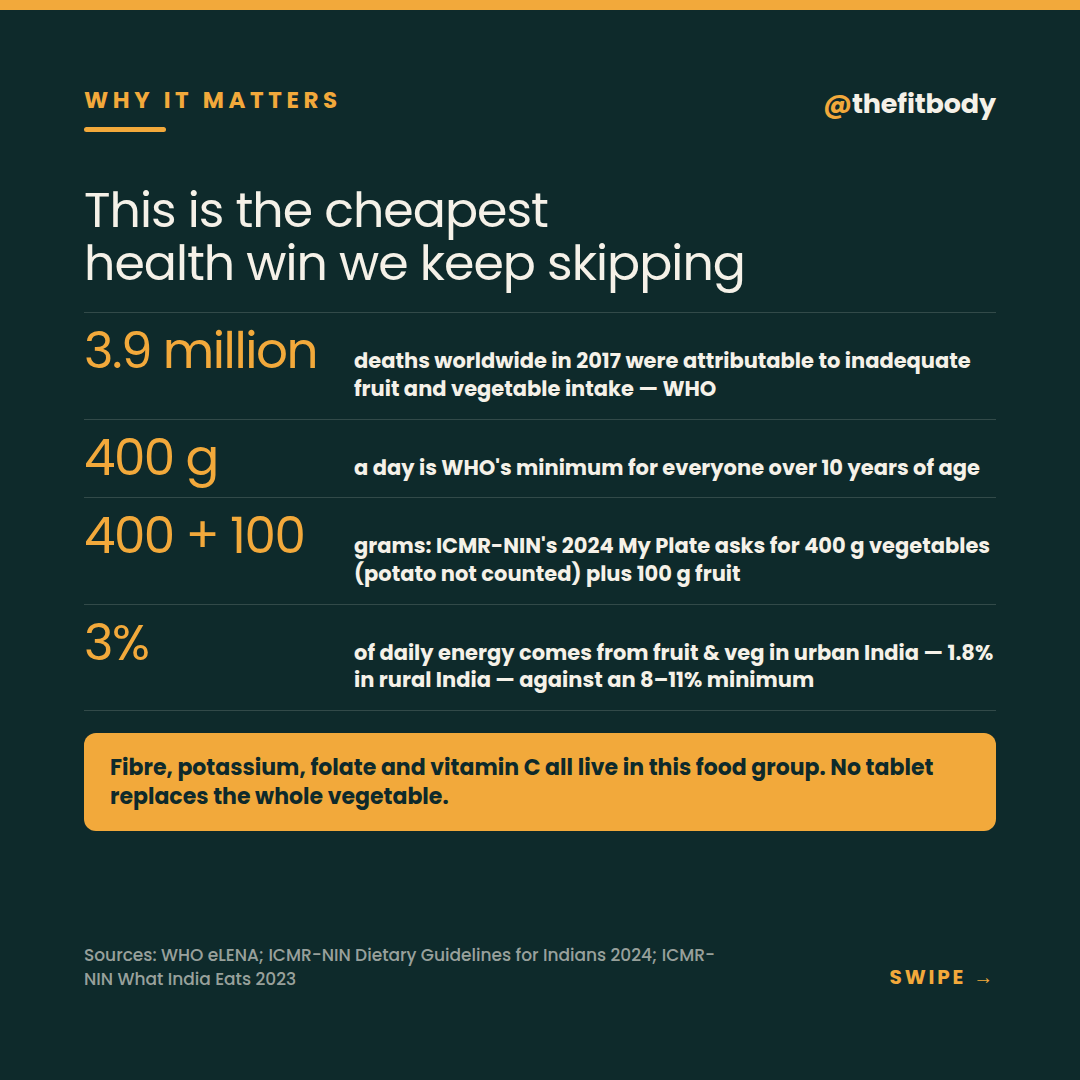
WHO recommends at least 400 g of fruit and vegetables a day. ICMR-NIN’s 2024 My Plate says 400 g of vegetables — potato not counted — plus 100 g of fruit.
What India actually eats is far from that, and the gap is widest in the places people assume it is smallest: the daily sabzi and the glass of juice.
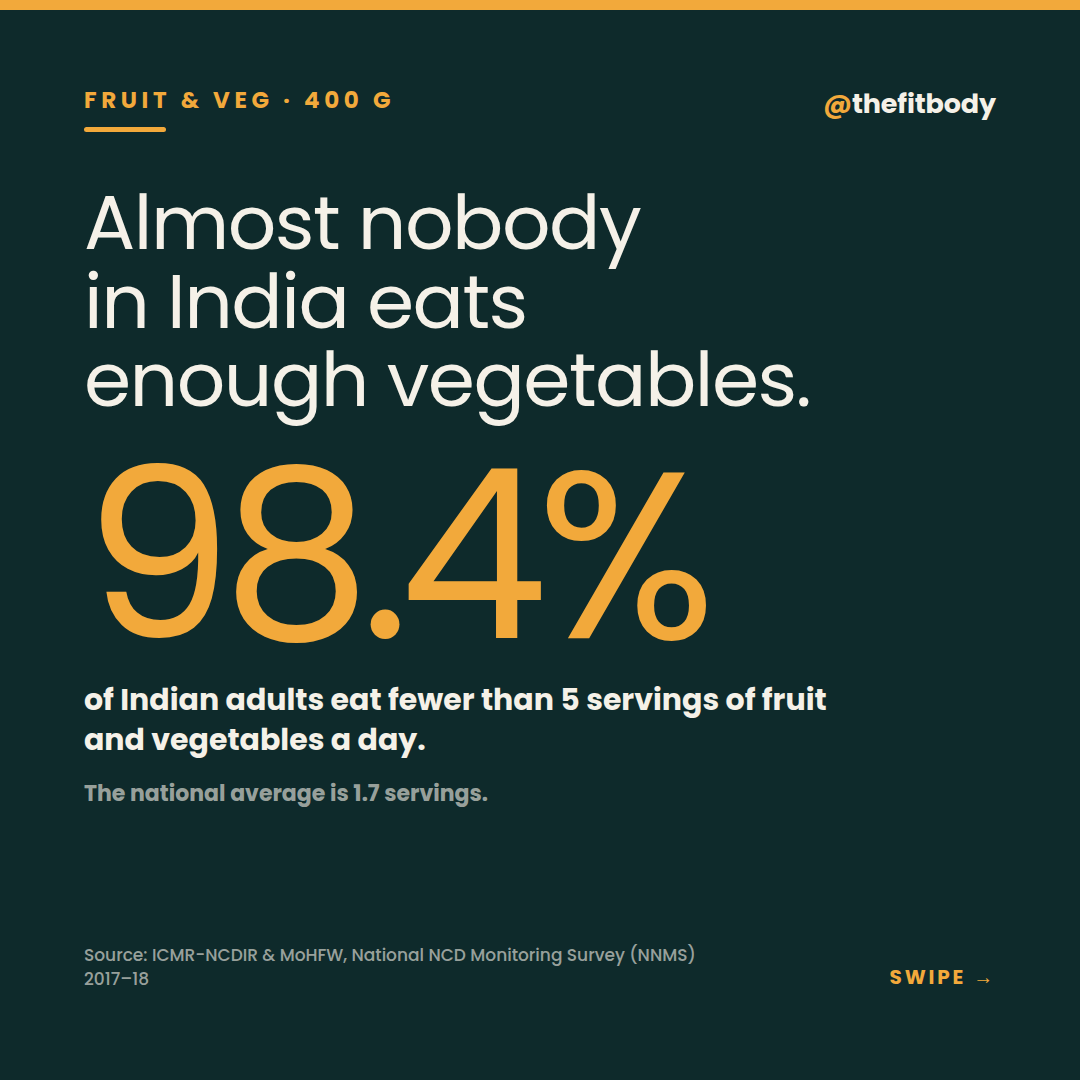
98.4%.
That's how many Indian adults eat less fruit and veg than they should. The national average is 1.7 servings a day. The mark is 5.
(ICMR-NCDIR & MoHFW, National NCD Monitoring Survey 2017–18)
WHO says at least 400 g of fruit and vegetables a day for everyone over 10.
ICMR-NIN's 2024 My Plate says 400 g vegetables — potato not counted — plus 100 g fruit.
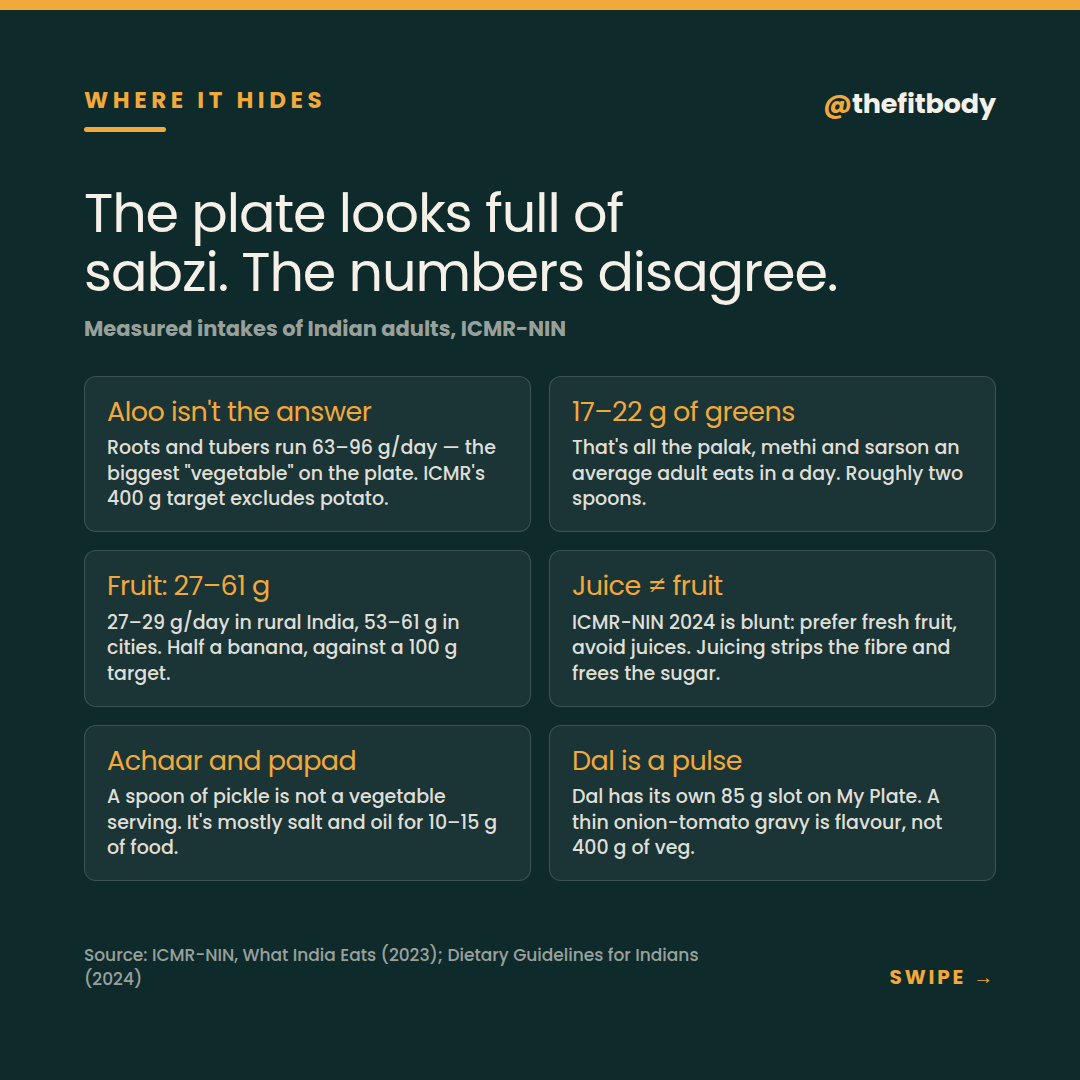
What we actually eat (ICMR-NIN, What India Eats 2023):
- Green leafy veg: 17–22 g a day. Two spoons of palak.
- Fruit: 27–29 g rural, 53–61 g urban. Half a banana.
- Roots and tubers: 63–96 g. Aloo is the biggest "vegetable" on the plate — and ICMR doesn't count it.
- Fruit and veg give us 3% of daily energy in cities, 1.8% in villages. The minimum is 8–11%.
Worldwide, 3.9 million deaths in 2017 were attributable to inadequate fruit and vegetable intake (WHO).
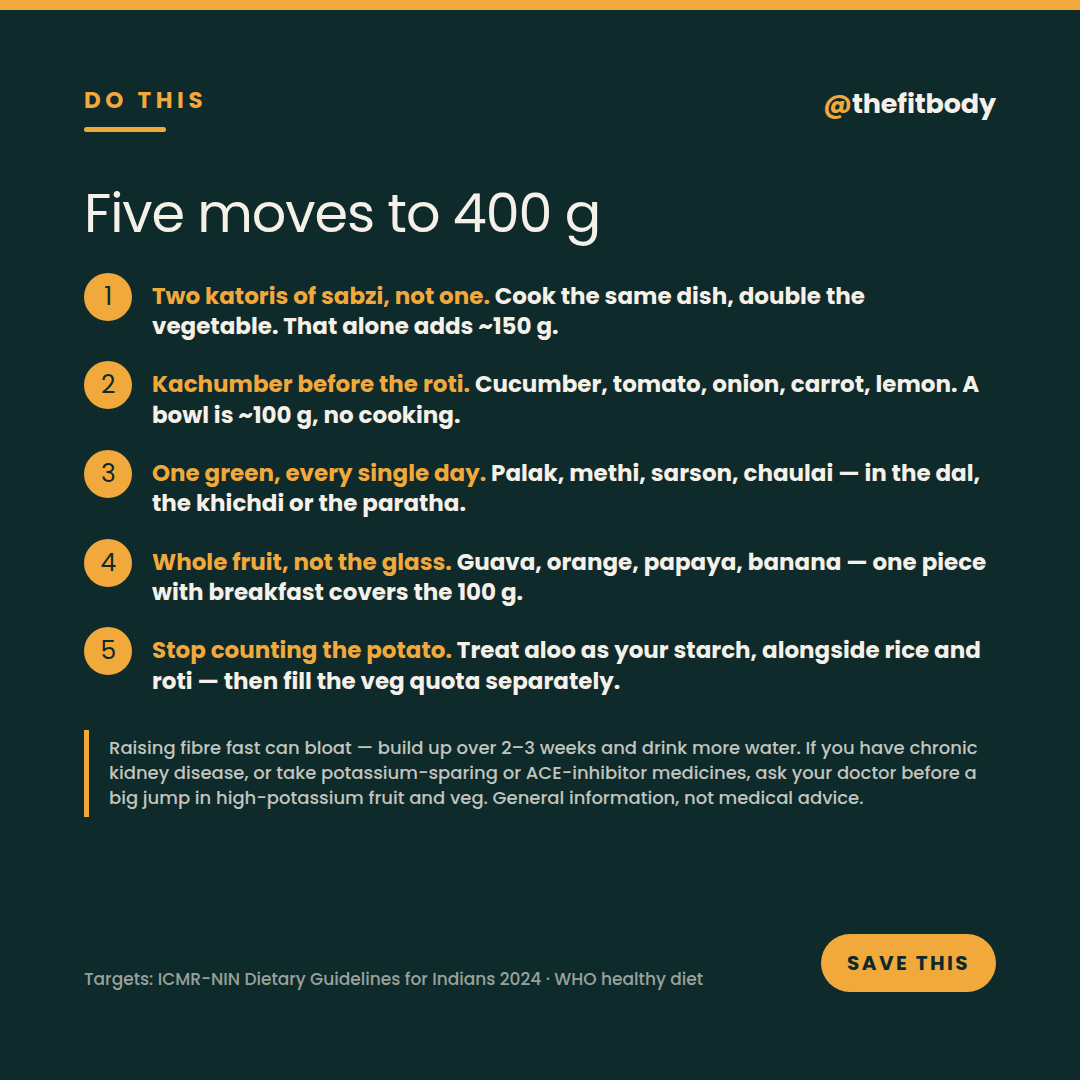
Five fixes:
- Two katoris of sabzi, not one. Same dish, double the veg. That's ~150 g right there.
- Kachumber before the roti. Cucumber, tomato, onion, carrot, lemon. A bowl is ~100 g, no cooking.
- One green, every single day. Palak, methi, sarson, chaulai — in the dal, the khichdi or the paratha.
- Whole fruit, not the glass. Guava, orange, papaya, banana. ICMR-NIN 2024 is blunt: prefer fresh fruit, avoid juices.
- Stop counting the potato. Treat aloo as your starch, next to rice and roti — then fill the veg quota separately.
One caution: raise fibre gradually, over 2–3 weeks, and drink more water, or you'll bloat. If you have chronic kidney disease, or take potassium-sparing or ACE-inhibitor medicines, ask your doctor before a big jump in high-potassium fruit and veg.
Getting to 400 g without a new recipe
Two katoris of sabzi (about 150 g) plus a bowl of kachumber before the roti (about 100 g) already puts you well past half of the vegetable target. A green in the dal or paratha and a whole fruit in the afternoon take care of the rest.
The carousel
The five slides from our Instagram and X post — swipe through them, save them, share them.
Sources
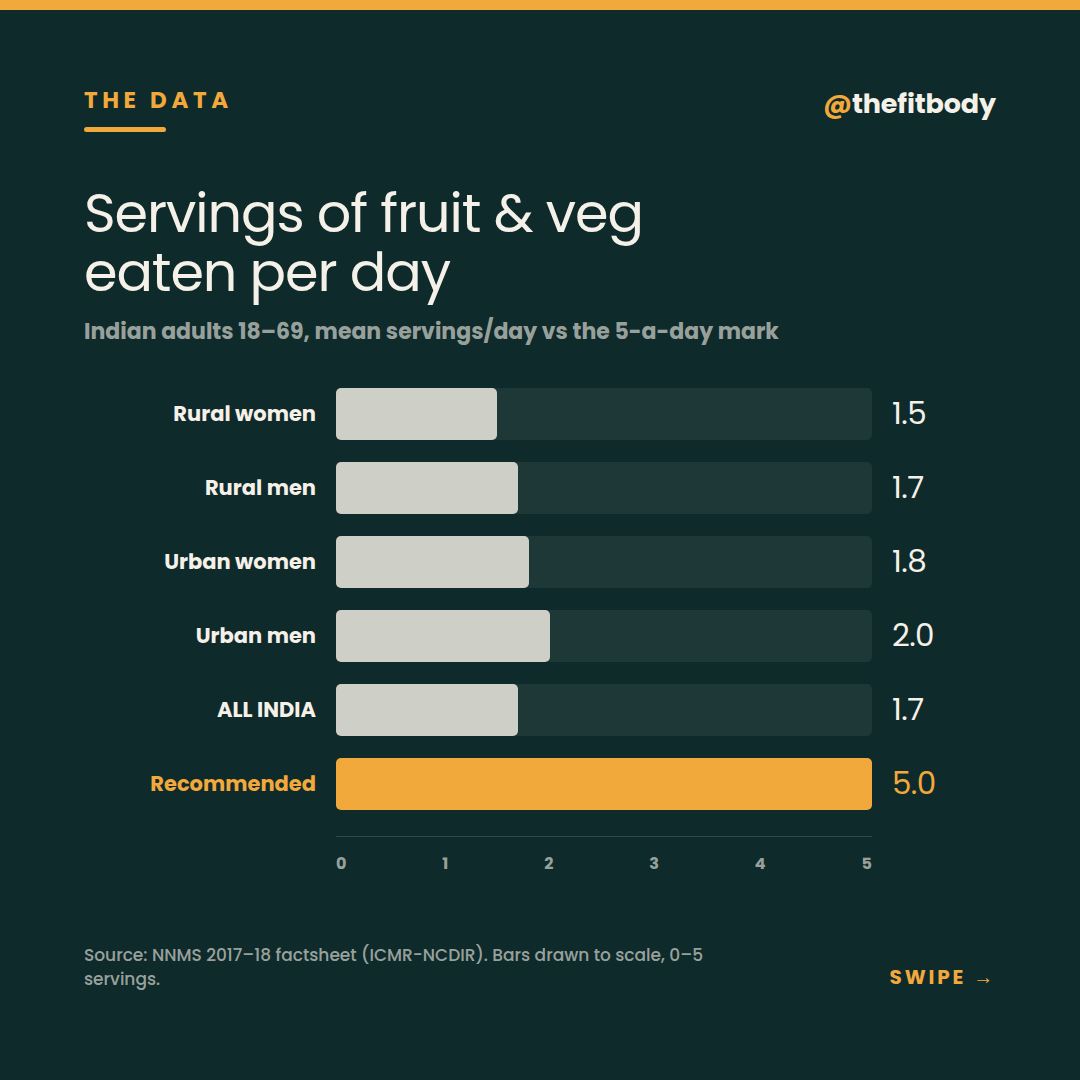
- National Noncommunicable Disease Monitoring Survey (NNMS) 2017–18 — factsheet98.4% of adults 18–69 eat fewer than 5 servings of fruit/veg a day · mean 1.7 servings/day · rural women 1.5, rural men 1.7, urban women 1.8, urban men 2.0
- Dietary Guidelines for Indians, 2024 — My Plate for the Day400 g vegetables a day (potato excluded) + 100 g fruit · pulses 85 g · “prefer fresh fruits, avoid juices”
- What India Eats, 2023Green leafy veg 17–22 g/day · fruit 27–29 g rural and 53–61 g urban · roots & tubers 63–96 g/day · fruit and veg supply 3% of energy urban, 1.8% rural vs an 8–11% minimum
- Healthy diet — fact sheetAt least 400 g of fruits and vegetables a day for everyone older than 10
- Increasing fruit and vegetable consumption to reduce NCDs (eLENA)3.9 million deaths worldwide in 2017 attributable to inadequate fruit and vegetable intake
General information, not medical advice. Figures are taken from the sources above; if you have a medical condition, speak to your doctor before changing your diet or activity.