
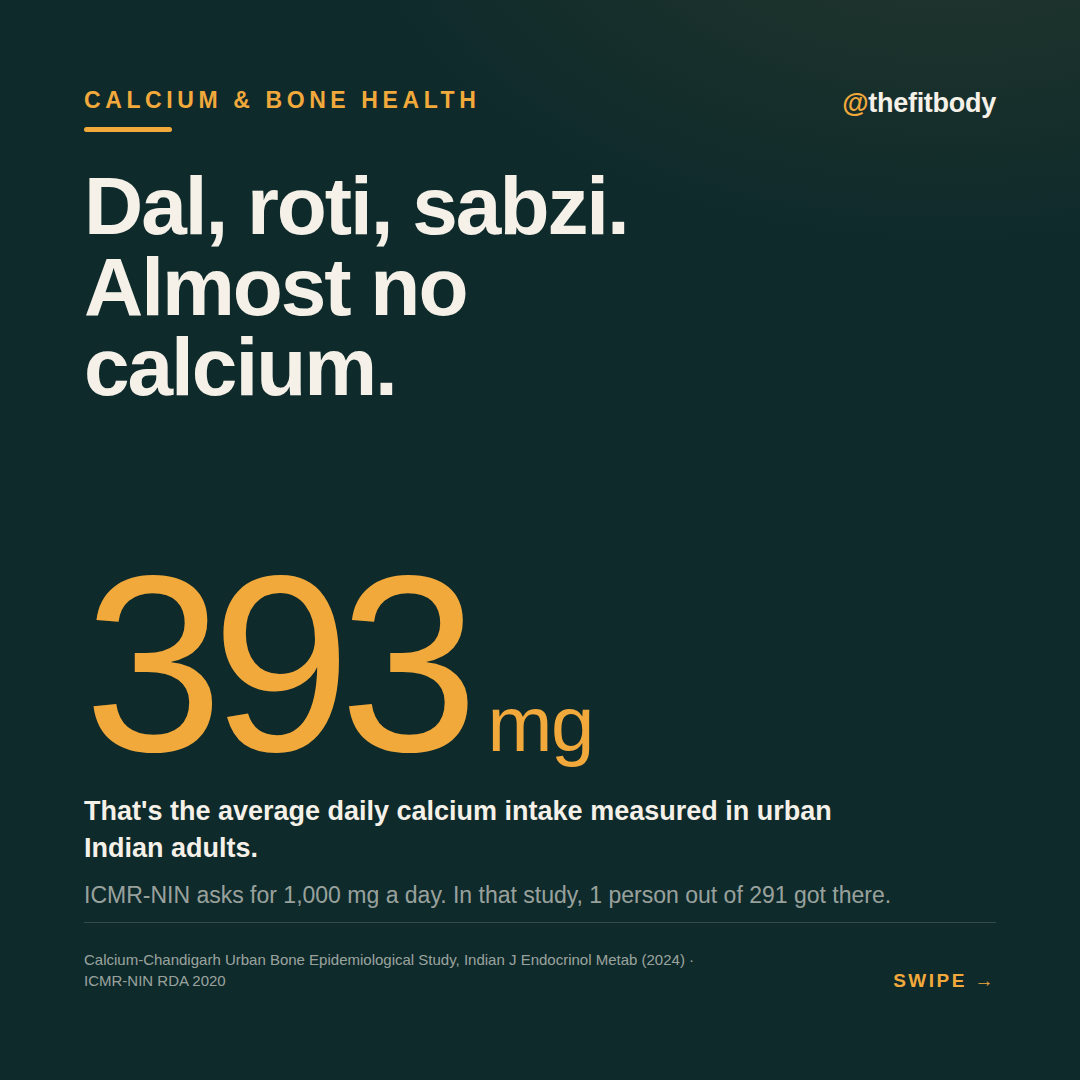
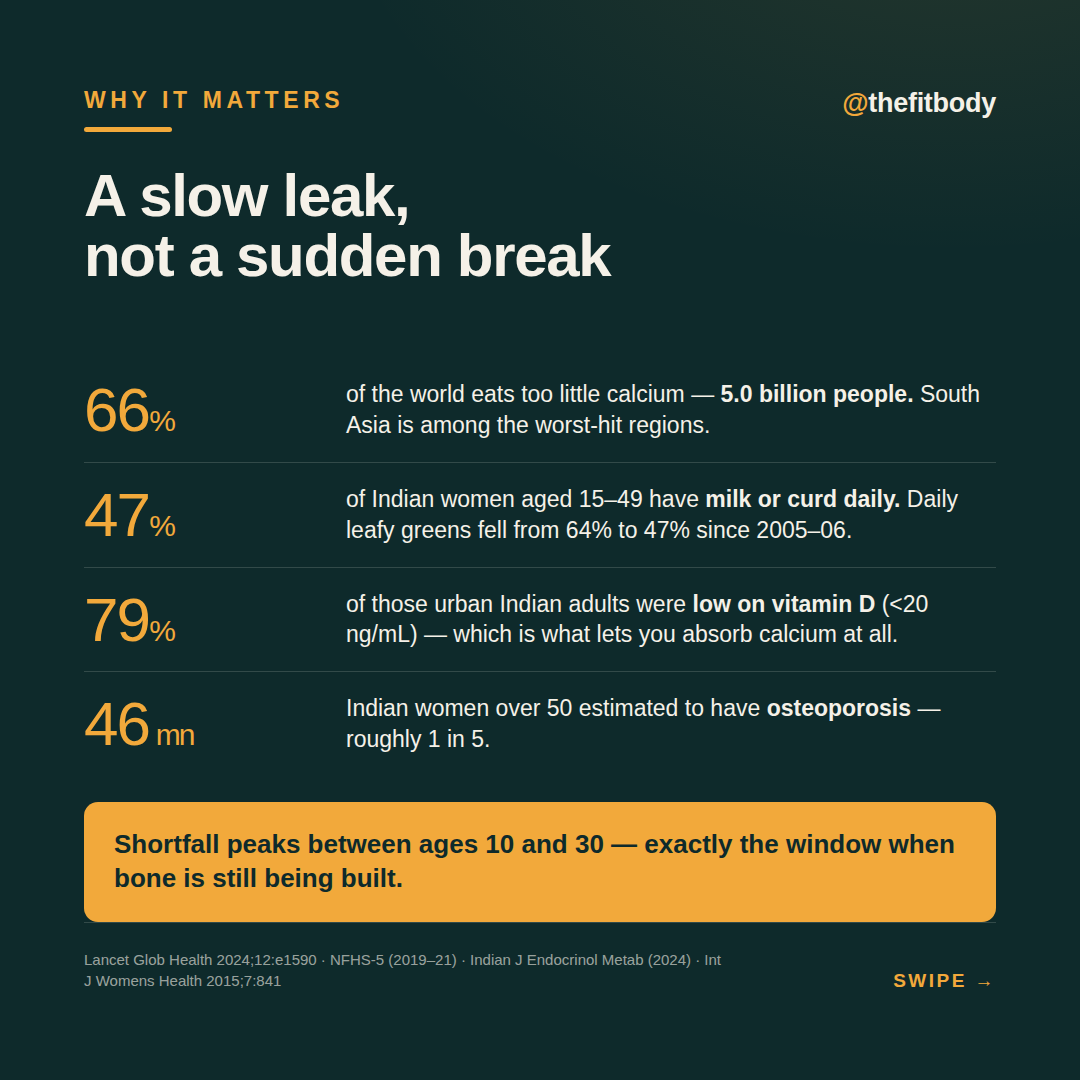
Cereal-heavy diets land near 300–400 mg of calcium a day. The shortfall peaks between ages 10 and 30 — exactly when bone is still being built.
Ragi gets the headlines, but millets bring only 60 mg per 100 g. The 300 ml of milk or curd in ICMR’s My Plate is what actually closes the gap.
The Numbers
- 66% of the world eats too little calcium — 5 billion people. South Asia is among the worst-hit.
- Only 47% of Indian women aged 15–49 have milk or curd daily. Daily leafy greens fell from 64% to 47% since 2005–06.
- 79% of those urban adults were low on vitamin D (<20 ng/mL) — which is what lets you absorb calcium.
- ~46 million Indian women over 50 are estimated to have osteoporosis.
- The shortfall peaks between 10 and 30 — exactly when bone is still being built.
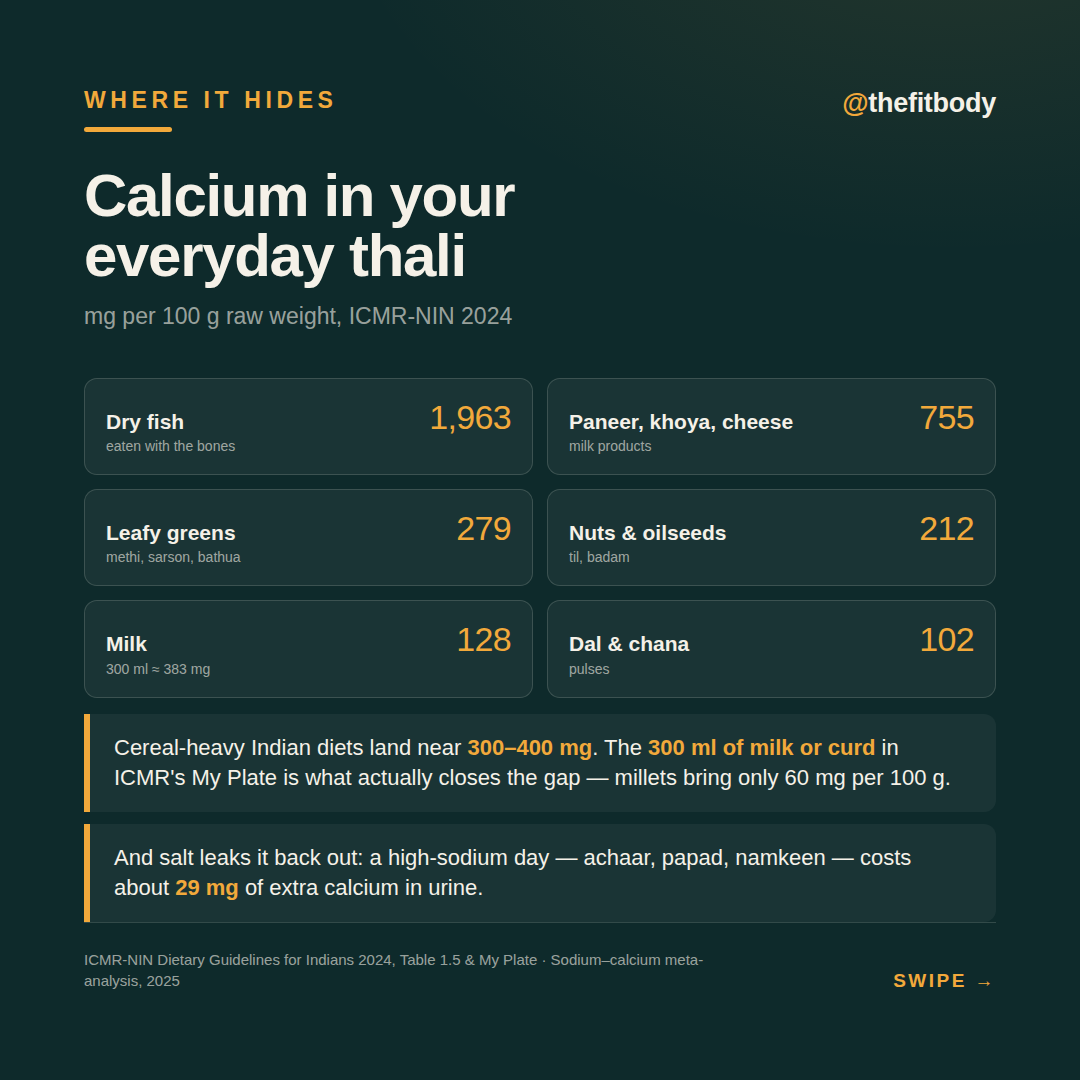
WHERE IT HIDES (mg per 100 g, ICMR-NIN 2024)
Dry fish, bones and all — 1,963
Paneer, khoya, cheese — 755
Leafy greens (methi, sarson, bathua) — 279
Til, badam — 212
Milk — 128 (300 ml ≈ 383 mg)
Dal, chana — 102
Millets — 60
Cereal-heavy diets land near 300–400 mg. Ragi gets the headlines, but millets bring only 60 mg per 100 g. The 300 ml of milk or curd in ICMR's My Plate is what actually closes the gap. And salt leaks it back out — a high-sodium day of achaar, papad and namkeen costs about 29 mg of calcium in your urine.
Do This
- 300 ml milk or curd daily — one glass, one katori dahi.
- 35 g of til or badam. Til chutney, chikki, laddoo.
- Leafy greens most days — methi, sarson, bathua, drumstick leaves.
- Cut the achaar-papad-namkeen salt load.
- Sun plus weight-bearing work. Vitamin D unlocks absorption; walking, stairs and resistance work tell bone to hold the mineral.
Food first. Don't start calcium supplements on your own — high doses can raise kidney-stone risk or clash with your medicines. If you have kidney disease, a thyroid or parathyroid condition, or take thyroid or BP drugs, ask your doctor first.
A calcium-smart day on an Indian plate
- A glass of milk or a katori of dahi — 300 ml of milk alone gives about 383 mg.
- Methi, sarson or bathua in the sabzi or paratha at lunch.
- Til chutney or a til laddoo as a snack.
- A short walk in daylight, and a few stair climbs, to give the calcium a reason to stay in bone.
The carousel
The five slides from our Instagram and X post — swipe through them, save them, share them.

Sources
- ICMR-NIN — Dietary Guidelines for Indians, 2024Table 1.5, calcium per 100 g raw weight: dry fish 1,962.6 · milk products 755.0 · green leafy vegetables 279.3 · nuts & oilseeds 211.6 · milk 127.6 · pulses 102.2 · millets 60.4. My Plate daily amounts: 300 ml milk or curd, 35 g nuts & seeds, 400 g vegetables. Also the line on sunlight and vitamin D.
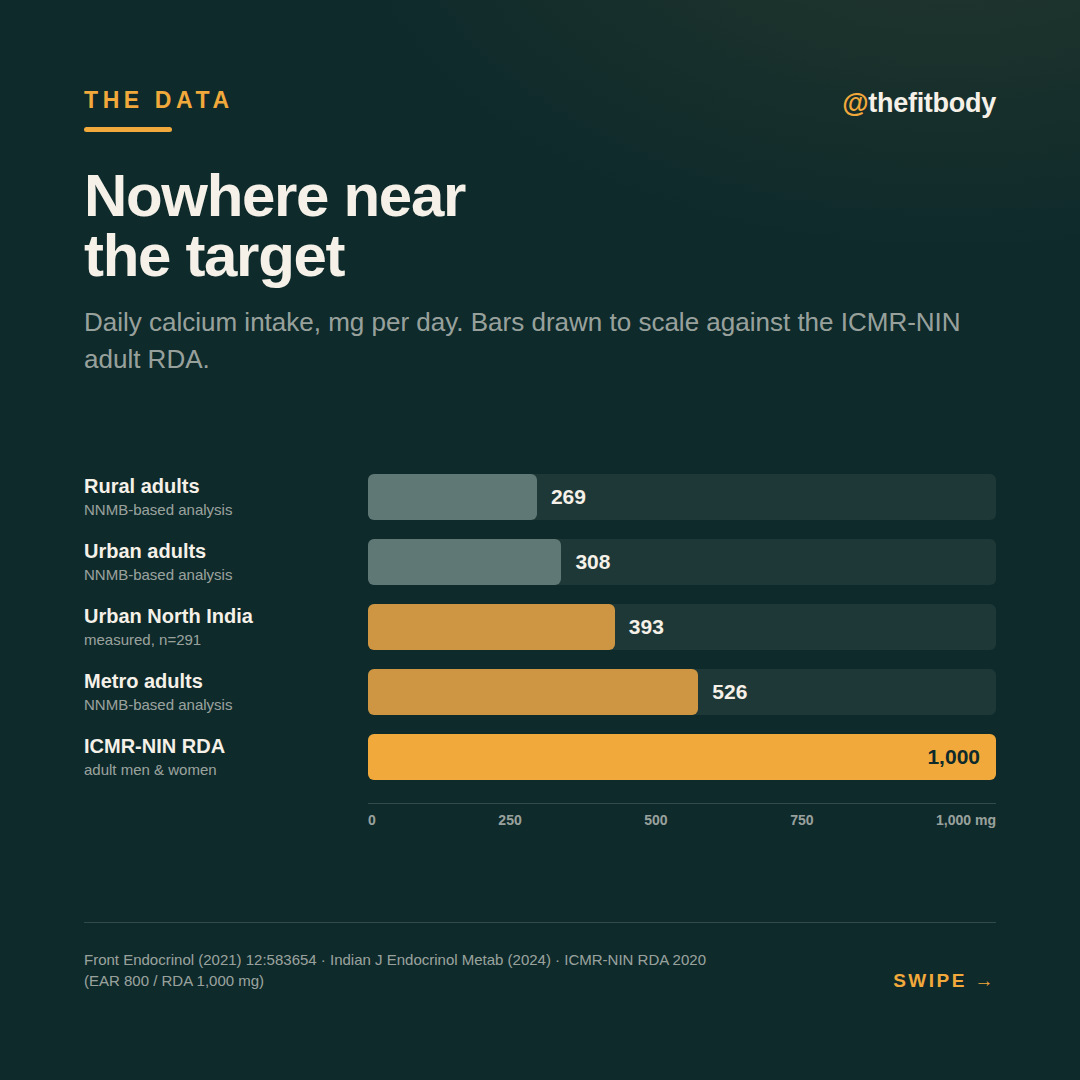
- ICMR-NIN — Nutrient Requirements for Indians, RDA 2020The 1,000 mg/day calcium RDA for adult men and women, and the 800 mg EAR behind it — the benchmark every bar on slide 2 is measured against.
- Calcium-Chandigarh Urban Bone Epidemiological Study — Indian J Endocrinol Metab, 2024The headline 392.6 ± 169.1 mg/day mean intake (n = 291); 1 participant of 291 reaching 1,000 mg; and 78.6% with 25(OH)D below 20 ng/mL, rounded to 79% on slide 3.
- Passarelli et al. — Global estimation of dietary micronutrient inadequacies, Lancet Global Health, 202466% of the global population — 5.0 billion people — with inadequate calcium intake; South Asia among the worst-affected regions; and the finding that inadequacy peaks at ages 10–30, which is the callout on slide 3.
- National Family Health Survey (NFHS-5), 2019–21 — MoHFW47% of women and 49% of men aged 15–49 consuming milk or curd daily, and daily dark green leafy vegetables among women falling from 64% (2005–06) to 47% (2019–21).
- Modern India and dietary calcium deficiency — Front Endocrinol, 2021;12:583654The rural 269 mg, urban 308 mg and metro 526 mg per day intake figures plotted on slide 2, drawn from NNMB survey data.
- Mithal & Kaur — Epidemiology and treatment of osteoporosis in women: an Indian perspective, Int J Womens Health, 2015;7:841The ~46 million estimate: of 230 million Indians expected to be over 50 in 2015, about 20% were women with osteoporosis.
- High salt intake and bone health in postmenopausal women — systematic review and meta-analysis, 2025The 29 mg figure: pooled mean difference of 29.38 mg/day more urinary calcium (95% CI 12.31–46.46) on a high-sodium diet (>2.3 g Na) versus low (<1.2 g Na), across six RCTs.
General information, not medical advice. Figures are taken from the sources above; if you have a medical condition, speak to your doctor before changing your diet or activity.