
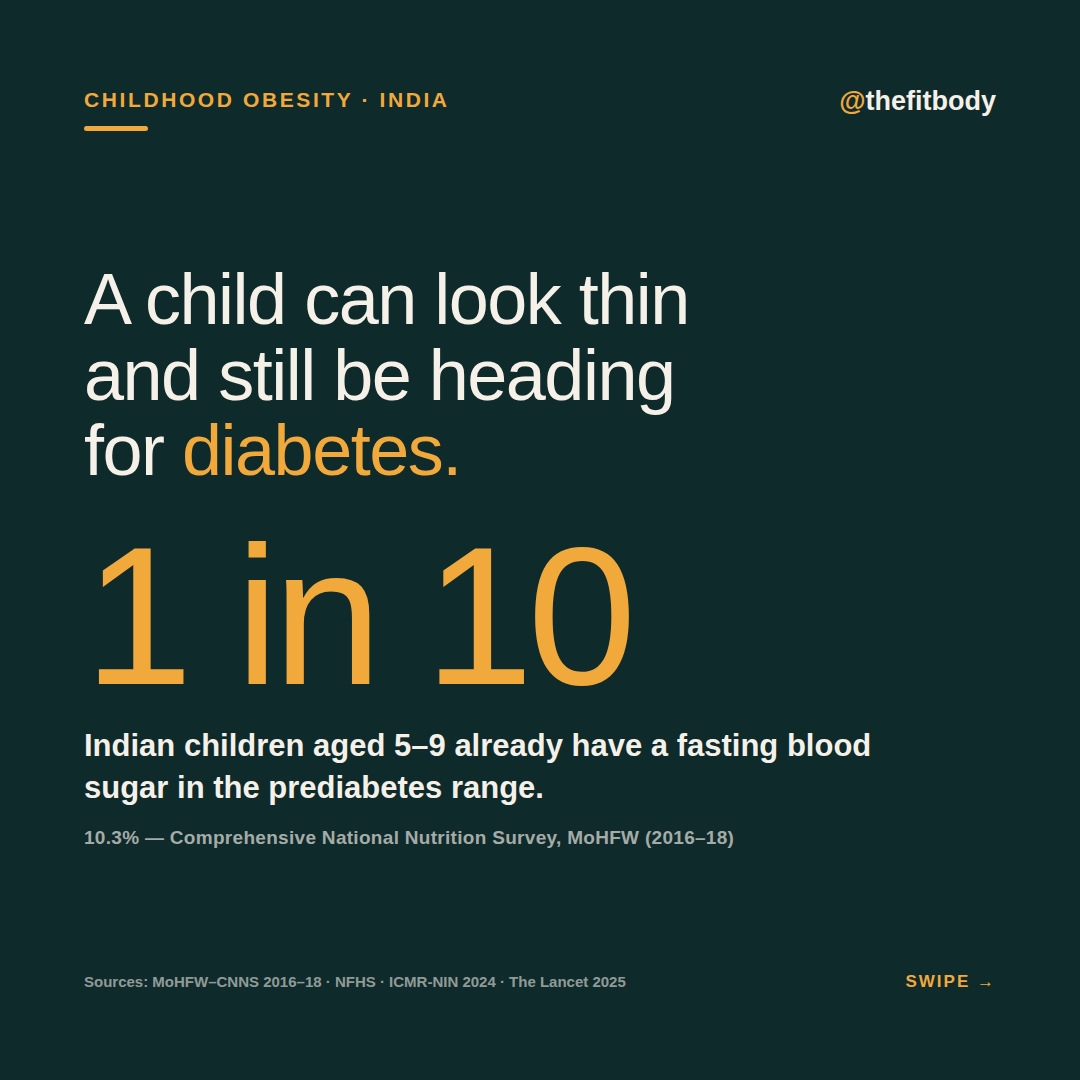
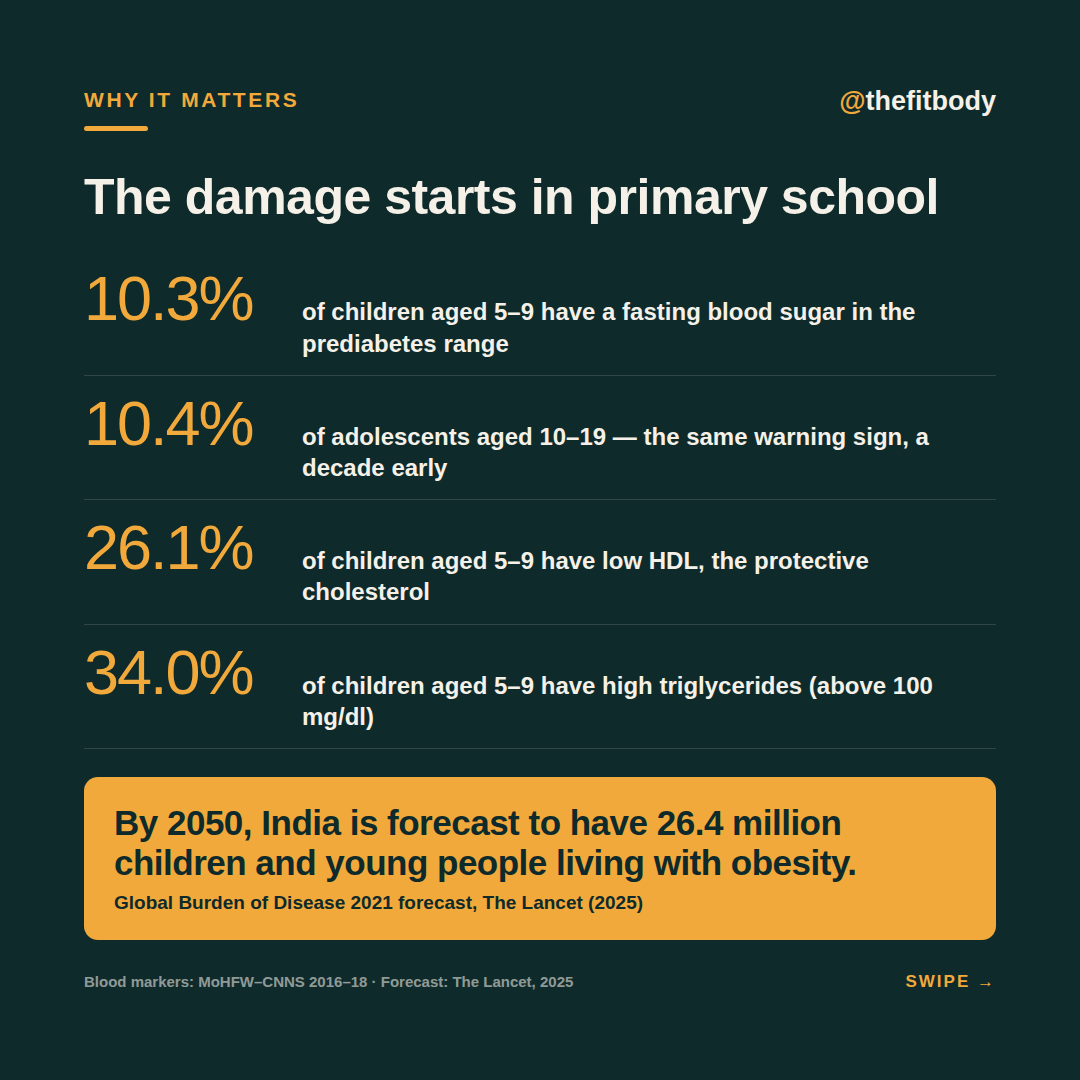
Childhood obesity is not only about a chubby child. The national nutrition survey found raised blood sugar, low protective HDL cholesterol and high triglycerides in children who did not look overweight at all.
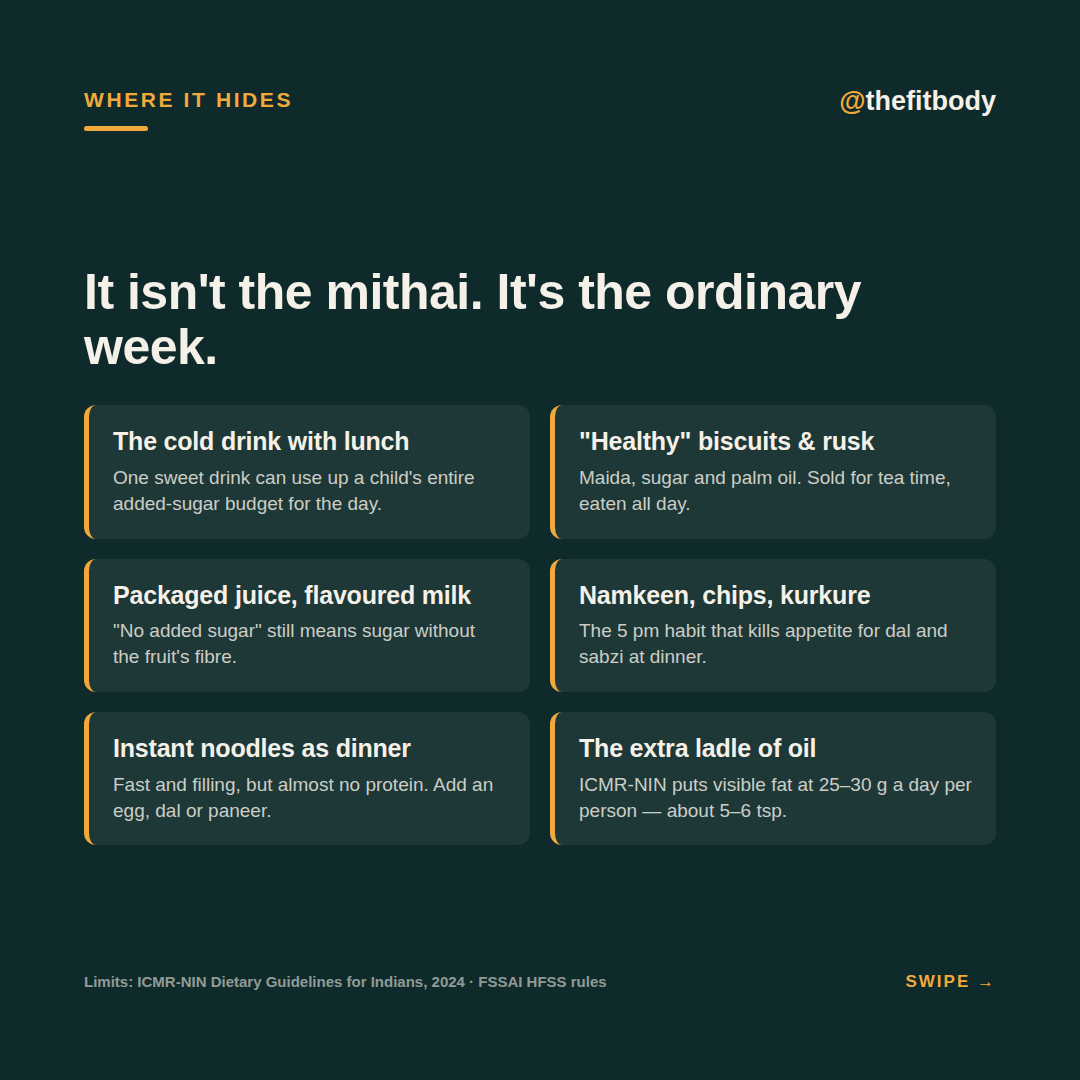
And it is not the Diwali mithai. It is the ordinary week: the daily cold drink, the biscuit packet and the 5 pm namkeen.
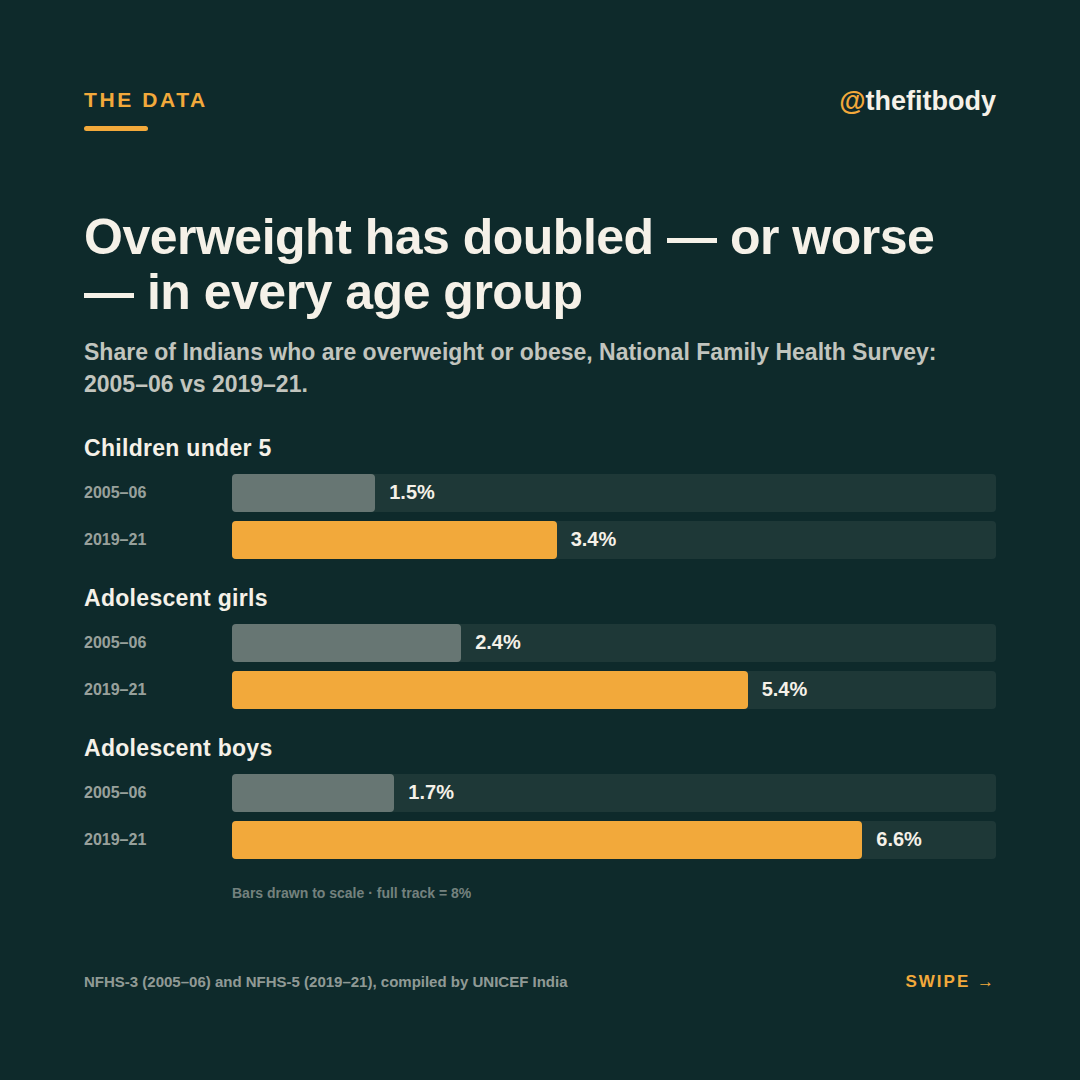
And the weight is climbing at every age. Overweight or obesity, NFHS-3 (2005–06) → NFHS-5 (2019–21):
- Children under 5: 1.5% → 3.4%
- Adolescent girls: 2.4% → 5.4%
- Adolescent boys: 1.7% → 6.6%
The same national survey found 26.1% of 5–9 year olds with low HDL — the protective cholesterol — and 34% with high triglycerides. By 2050, India is forecast to have 26.4 million children and young people living with obesity (The Lancet, 2025).
Here is the part parents miss: it is not the mithai at Diwali. It is the ordinary week.
— the cold drink with lunch
— "healthy" biscuits and rusk (maida, sugar, palm oil)
— packaged juice and flavoured milk
— namkeen, chips and kurkure at 5 pm
— instant noodles as dinner
— one extra ladle of oil in every sabzi
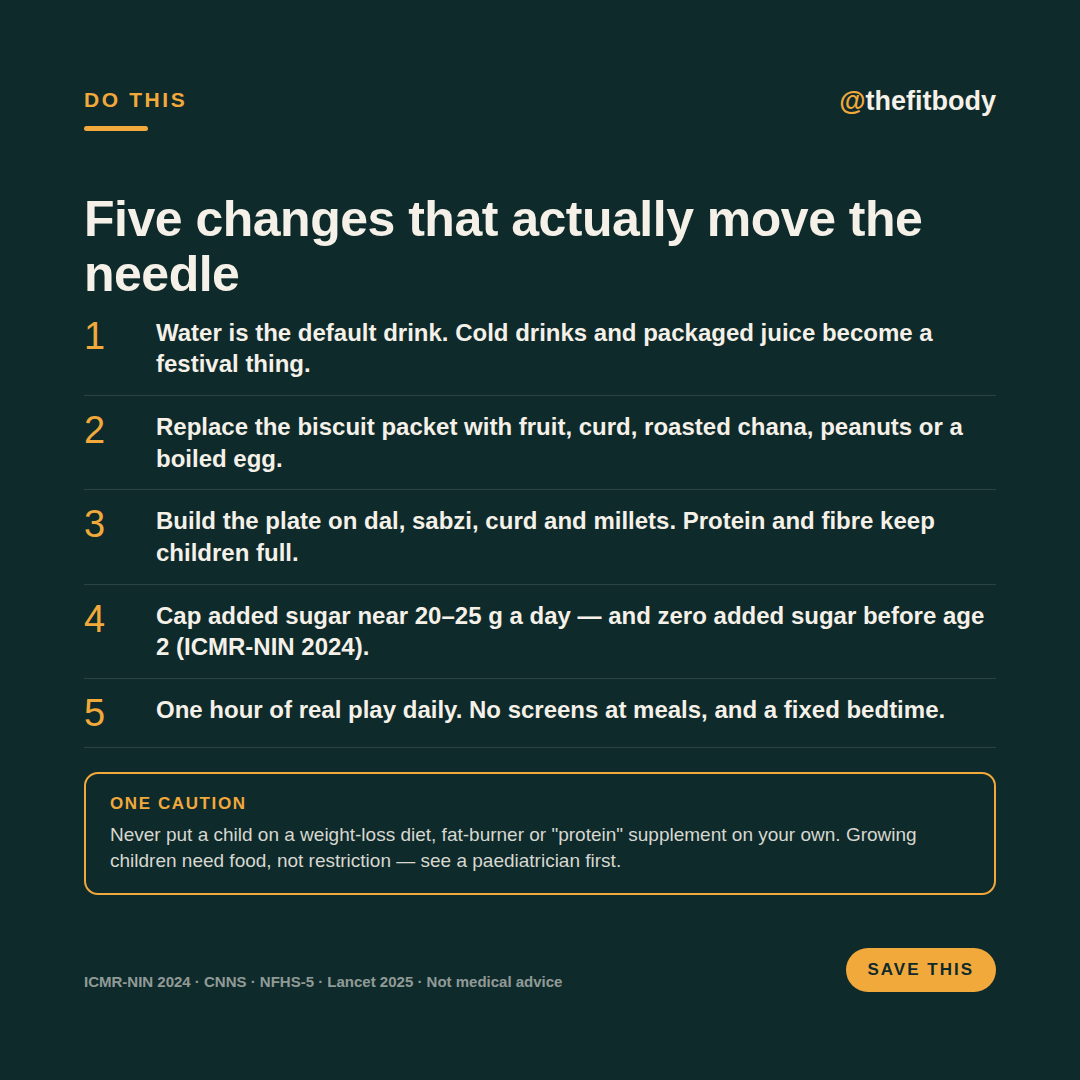
Five changes that actually move the needle:
- Water is the default drink. Sweet drinks become a festival thing.
- Replace the biscuit packet with fruit, curd, roasted chana, peanuts or a boiled egg.
- Build the plate on dal, sabzi, curd and millets. Protein and fibre keep children full.
- Keep added sugar near 20–25 g a day, and zero added sugar before age 2 (ICMR-NIN 2024).
- One hour of real play daily. No screens at meals, and a fixed bedtime.
One caution: never put a child on a weight-loss diet, a fat-burner or a "protein" supplement on your own. Growing children need food, not restriction — talk to a paediatrician first.
Growing children need food, not restriction
The answer is never a diet for a child. It is a better default: water instead of sweet drinks, fruit, curd, roasted chana or a boiled egg instead of the biscuit packet, and a plate built around dal, sabzi, curd and millets. Add an hour of real play and a fixed bedtime, and most of the work is done.
The carousel
The five slides from our Instagram and X post — swipe through them, save them, share them.
Sources
- CNNS India factsheet (PDF)10.3% of children 5–9 and 10.4% of adolescents 10–19 with high fasting blood glucose; 26.1% of 5–9s with low HDL; 34.0% with high triglycerides; overweight/obesity 3.7% (5–9) and 4.8% (10–19).
- NFHS figures compiled by UNICEF IndiaUnder-5 overweight 1.5% → 3.4%; adolescent girls 2.4% → 5.4%; adolescent boys 1.7% → 6.6% (slide 2 chart).
- Child and adolescent overweight and obesity, 1990–2021, forecasts to 2050India forecast to have 26.4 million children and young people living with obesity by 2050; 493 million young people worldwide with overweight or obesity in 2021.
- Dietary Guidelines for Indians 2024 (PDF)Added sugar under 5% of energy, about 20–25 g a day; no added sugar before age 2; visible fat 25–30 g a day; avoid ultra-processed and HFSS foods (slides 4 and 5).
- FSSAI notice on junk food near schools (PDF)HFSS foods cannot be sold or advertised in school canteens or within 50 m of a school campus (slide 4 footer).
- WHO guidelines, 2020An average of 60 minutes a day of moderate-to-vigorous activity for ages 5–17 (action 5).
General information, not medical advice. Figures are taken from the sources above; if you have a medical condition, speak to your doctor before changing your diet or activity.