
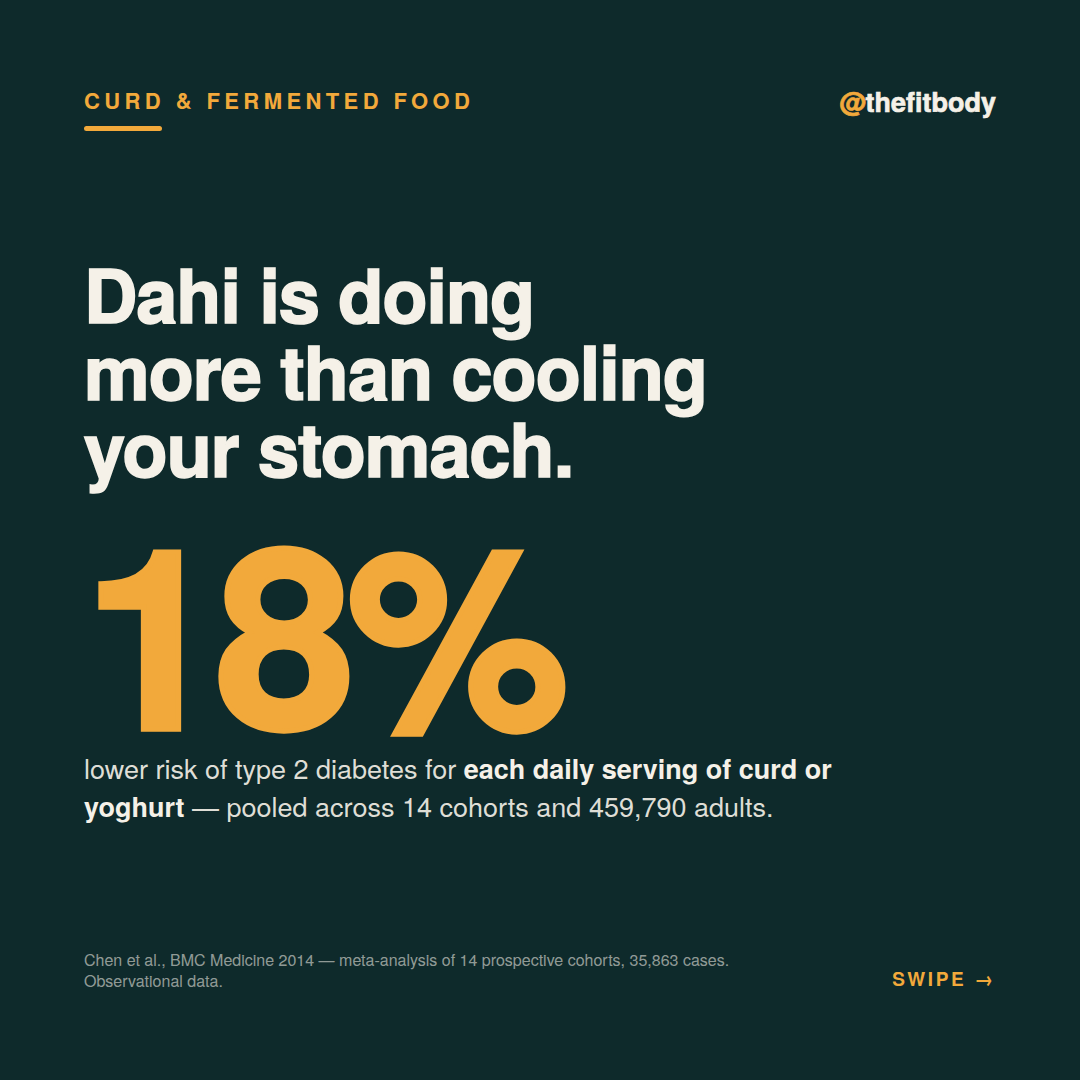
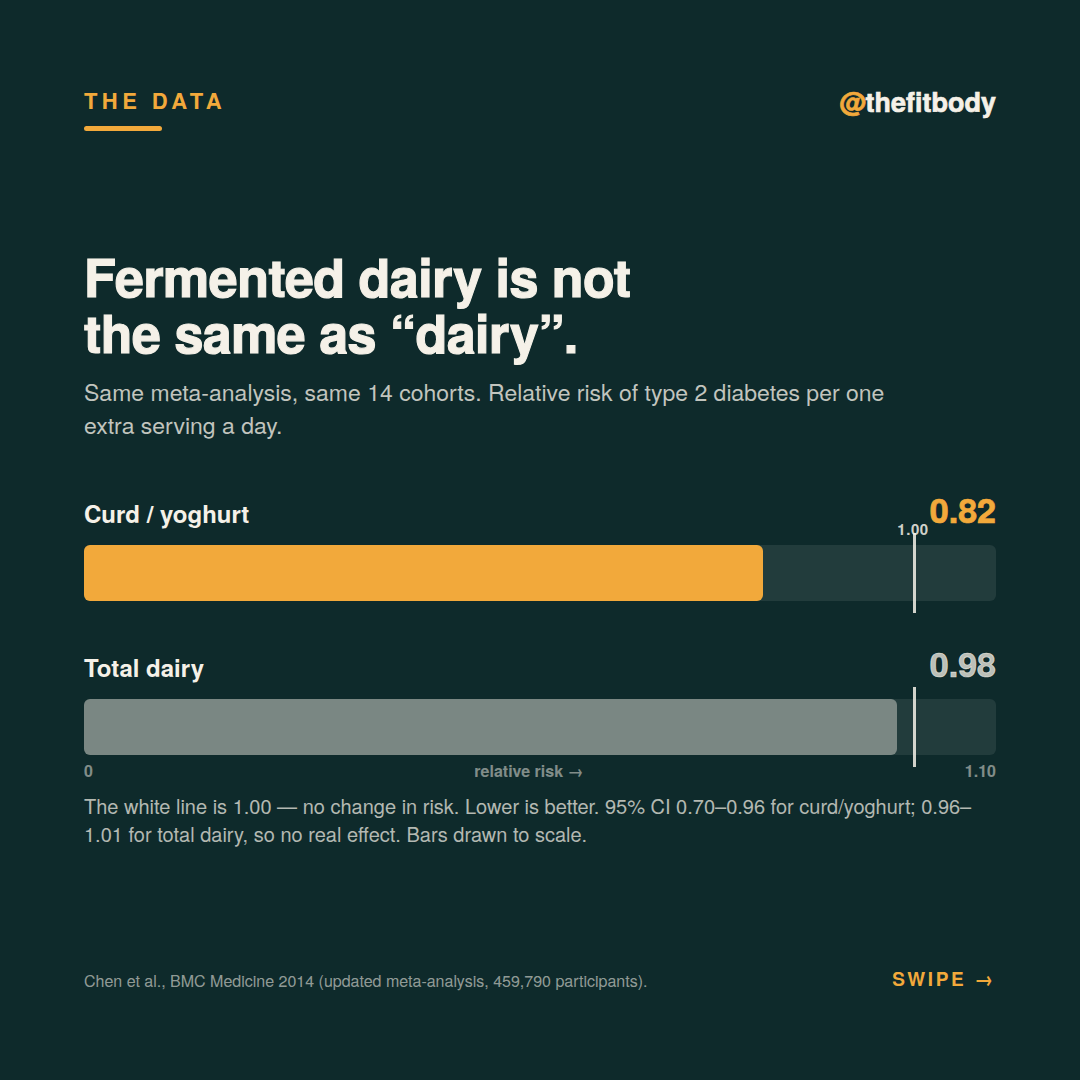
Pooled across 14 studies and 459,790 adults, curd and yoghurt carried a protective signal. Total dairy did not — it came out flat (RR 0.98). It is the fermented form that matters, not milk in general.
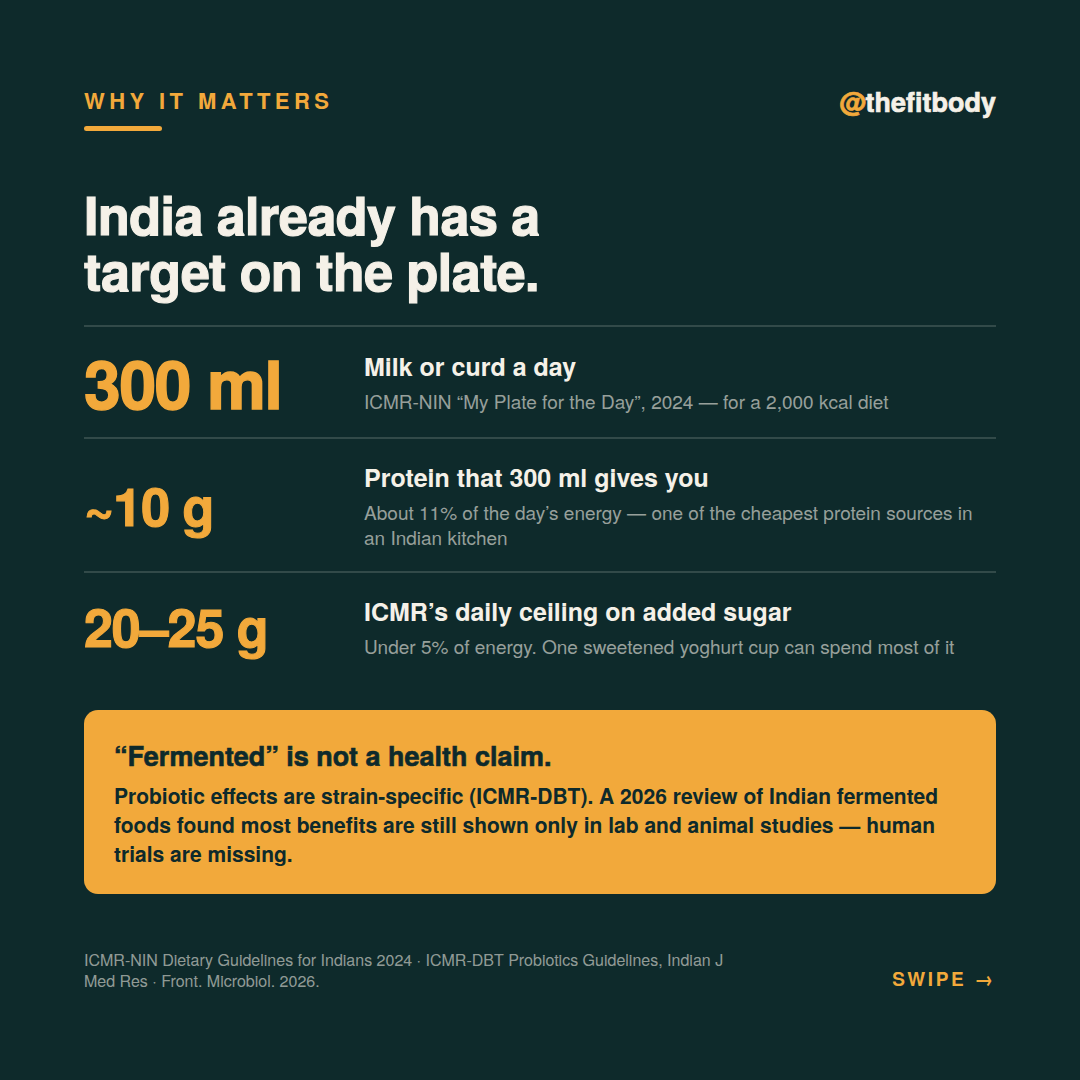
ICMR-NIN’s My Plate asks for 300 ml of milk or curd a day. The easiest way to meet it is a katori of plain dahi with lunch.
Here's the part most people miss. Total dairy showed nothing. RR 0.98. Flat.
It's the fermented form that carried the signal, not "milk" in general.
The Numbers
- 300 ml of milk or curd a day, ICMR-NIN "My Plate", 2024
- ~10 g protein from that 300 ml, about 11% of a 2,000 kcal day
- 20-25 g, ICMR's ceiling on added sugar, under 5% of energy
Where It Goes Wrong
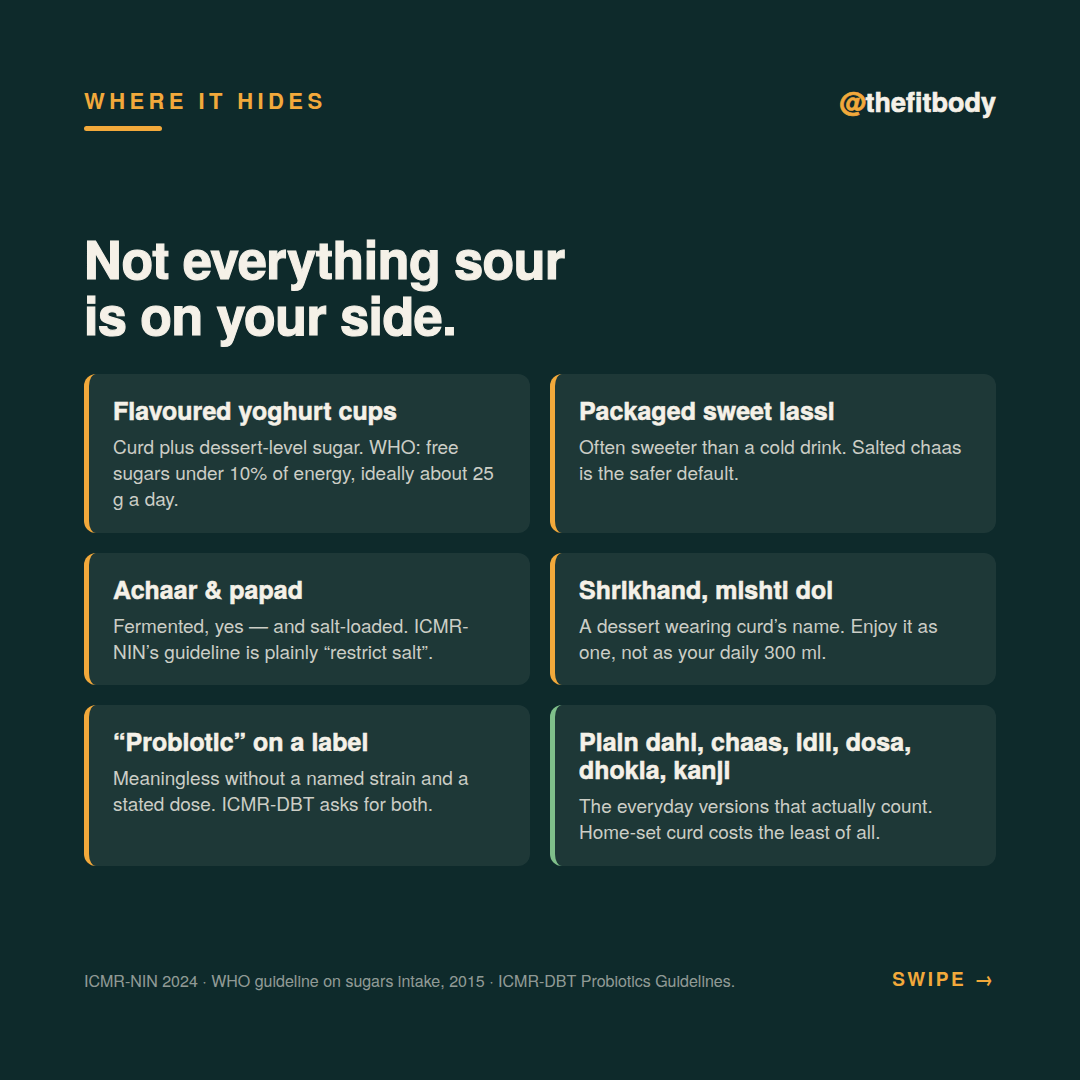
Flavoured yoghurt cups – curd plus dessert-level sugar
Packaged sweet lassi – often sweeter than a cold drink
Achaar and papad – fermented, yes, and salt-loaded
Shrikhand, mishti doi – a dessert wearing curd's name
"Probiotic" on a label – meaningless without a named strain and a dose
Five Moves
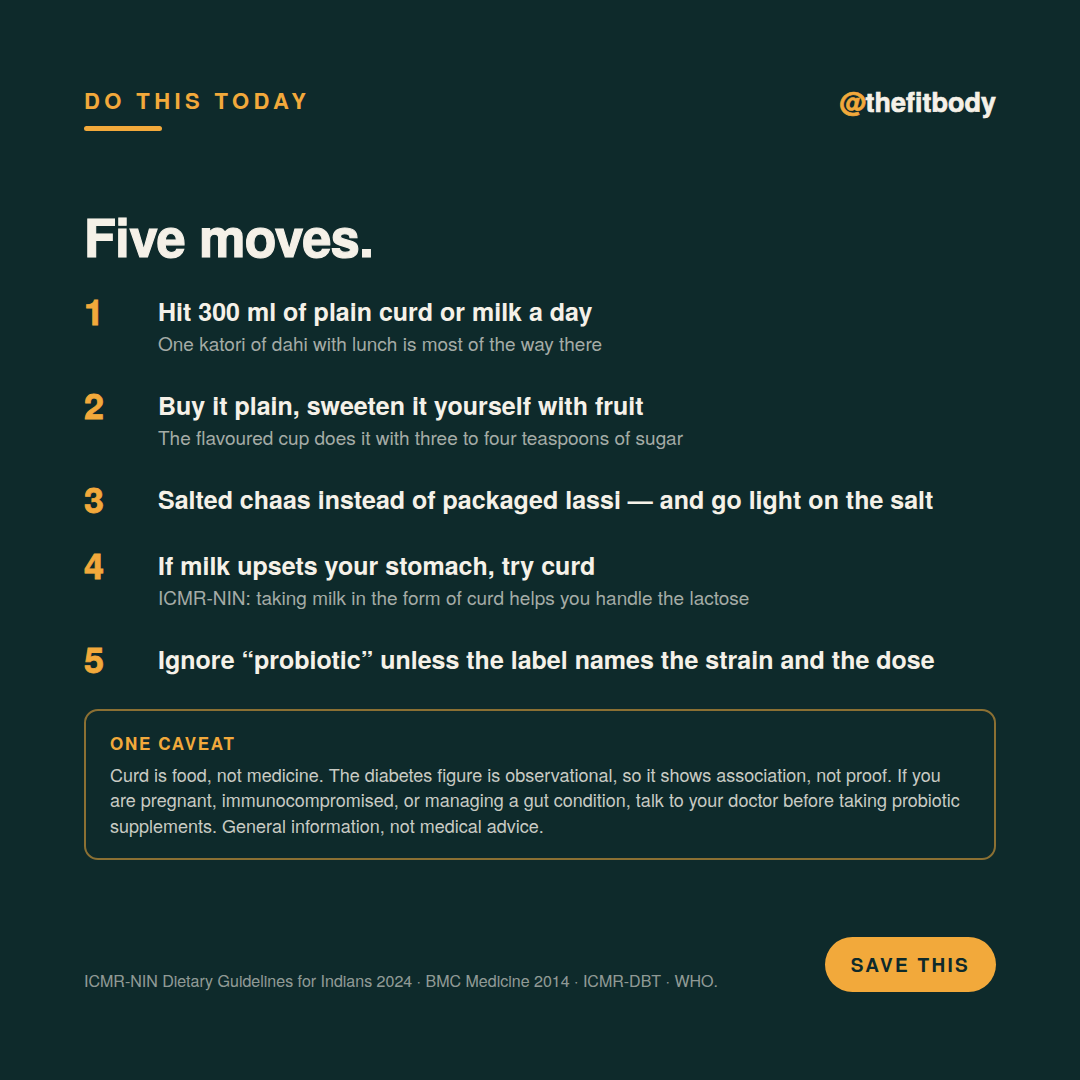
- Hit 300 ml of plain curd or milk a day. One katori of dahi with lunch is most of the way there.
- Buy it plain, add fruit yourself. The flavoured cup does it with three to four teaspoons of sugar.
- Salted chaas instead of packaged lassi, and go light on the salt.
- If milk upsets your stomach, try curd. ICMR-NIN says taking milk in the form of curd helps you handle the lactose.
- Ignore "probiotic" unless the label names the strain and the dose.
One caveat. Curd is food, not medicine. The diabetes figure is observational, so it shows association, not proof. A 2026 review of Indian fermented foods found most benefits are still shown only in lab and animal studies. If you are pregnant, immunocompromised or managing a gut condition, talk to your doctor before taking probiotic supplements.
Making curd work in an ordinary day
Keep it plain and keep it simple: a katori of set dahi with lunch, salted chaas with roasted jeera in the afternoon, a cucumber raita with dinner. Add your own fruit if you want sweetness. The point is that the fermented form is the one linked to the benefit — so the dessert versions don’t count, however ‘probiotic’ the label sounds.
The carousel
The five slides from our Instagram and X post — swipe through them, save them, share them.
Sources
- ICMR-NIN, Dietary Guidelines for Indians, 2024300 ml of milk or curd a day and ~10 g protein / ~11% of energy from it in "My Plate for the Day" (2,000 kcal). Added sugar 20–25 g/day, under 5% of energy . The line on lactose: taking milk in the form of curd helps. Also the salt guideline behind the achaar card.
- Chen M et al., BMC Medicine, 2014 — dairy and type 2 diabetesThe headline: yoghurt RR 0.82 (95% CI 0.70–0.96) per serving a day — the 18% figure. Total dairy RR 0.98 (0.96–1.01) . Updated meta-analysis of 14 prospective cohorts, 459,790 participants, 35,863 cases . Observational.
- ICMR-DBT Guidelines for Evaluation of Probiotics in Food, Indian J Med ResProbiotic effects are strain-specific, and the minimum effective dose in CFU has to be declared for the specific strain and claim. That is the basis for the "names the strain and the dose" rule on slides 4 and 5.
- WHO guideline on sugars intake for adults and children, 2015Free sugars under 10% of total energy, and a conditional under 5%, roughly 25 g a day — the number against which a flavoured yoghurt cup is measured on slide 4.
- Traditional Indian fermented foods review, Frontiers in Microbiology, 2026Covers idli, dosa, dhokla, dahi, kinema and others, and states plainly that most reported benefits come from in vitro and animal studies, with human clinical validation absent . That is the caveat band on slide 3.
- Fermented foods and gut bacteria in a rural Indian population, Nature Communications, 2025Background reading, not quoted on a slide: in 78 Meitei adults in Manipur, long-term fermented-food eaters showed lower faecal bacterial load (p < 0.001) and lower Shannon diversity — a reminder that "fermented" does not automatically mean "more diverse microbiome".
General information, not medical advice. Figures are taken from the sources above; if you have a medical condition, speak to your doctor before changing your diet or activity.