
We rarely decide to become less active. It happens quietly: the sabzi run becomes a scooter ride, groceries arrive in ten minutes, and the lift replaces two flights of stairs.
A large Lancet Public Health analysis tracked steps with devices — not memory — and found that the benefits start much earlier than most people think.
The Data
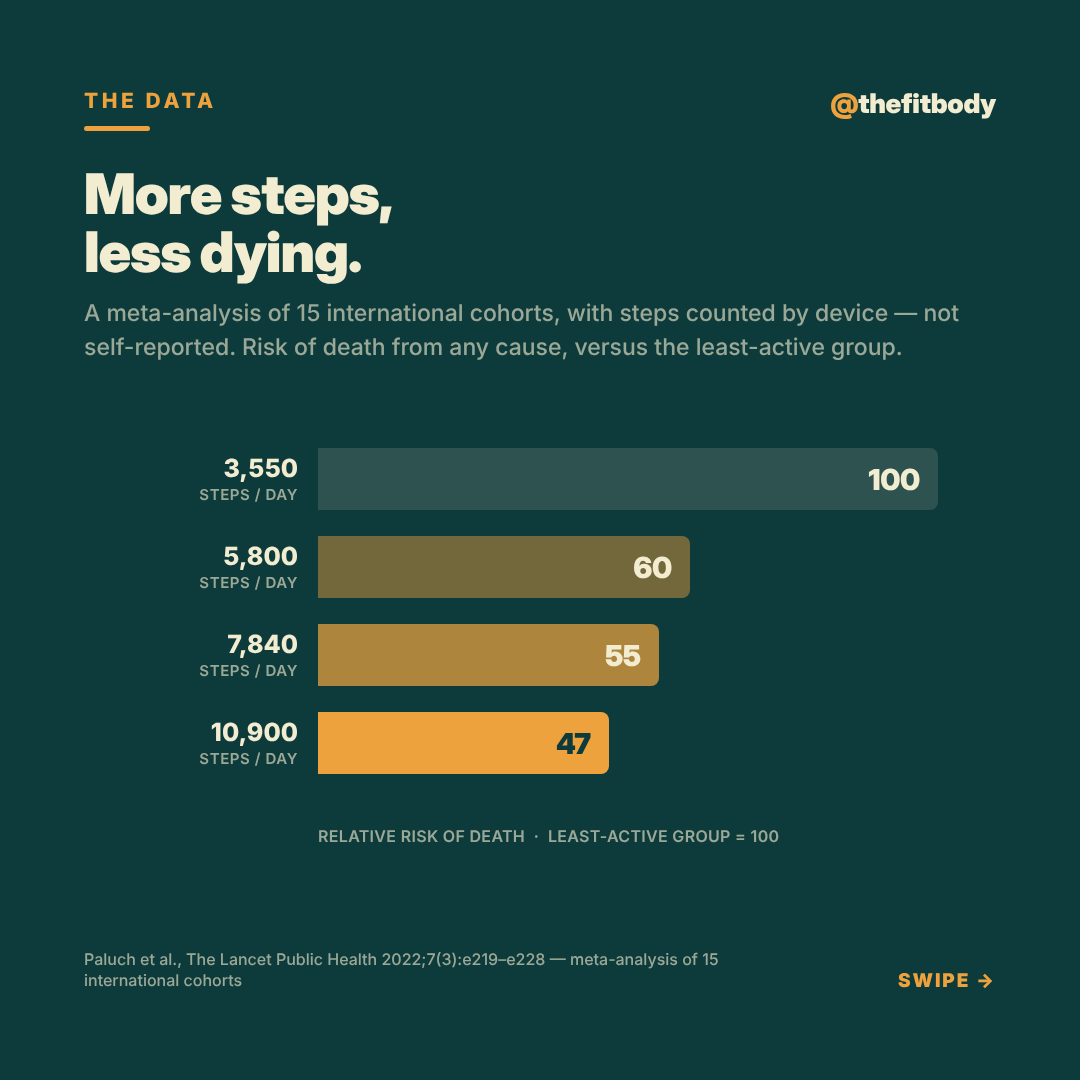
A Lancet Public Health meta-analysis of 15 cohorts tracked steps with devices, not memory. Against the least-active group (~3,550 steps/day):
~5,800 steps → 40% lower risk of dying
~7,840 steps → 45% lower
~10,900 steps → 53% lower
The curve flattens around 6,000–8,000 steps if you’re 60+, and 8,000–10,000 if you’re under 60. You don’t need 10k to benefit. You need to stop sitting.
Why It Matters Here
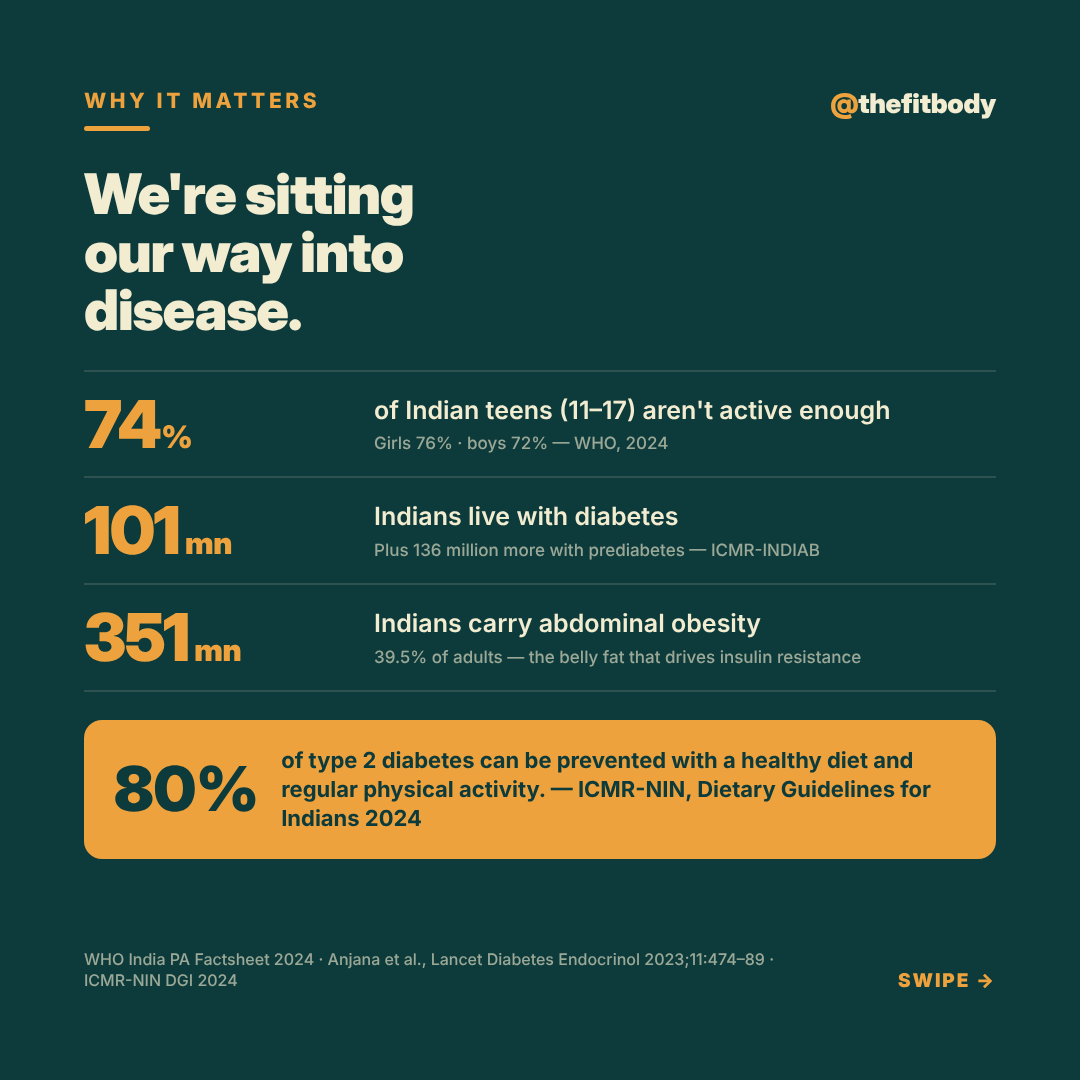
101 million Indians live with diabetes. 136 million more have prediabetes. 351 million carry abdominal obesity — 39.5% of adults. (ICMR-INDIAB)
ICMR-NIN: up to 80% of type 2 diabetes is preventable with a healthy diet and regular activity.
Where Your Steps Went
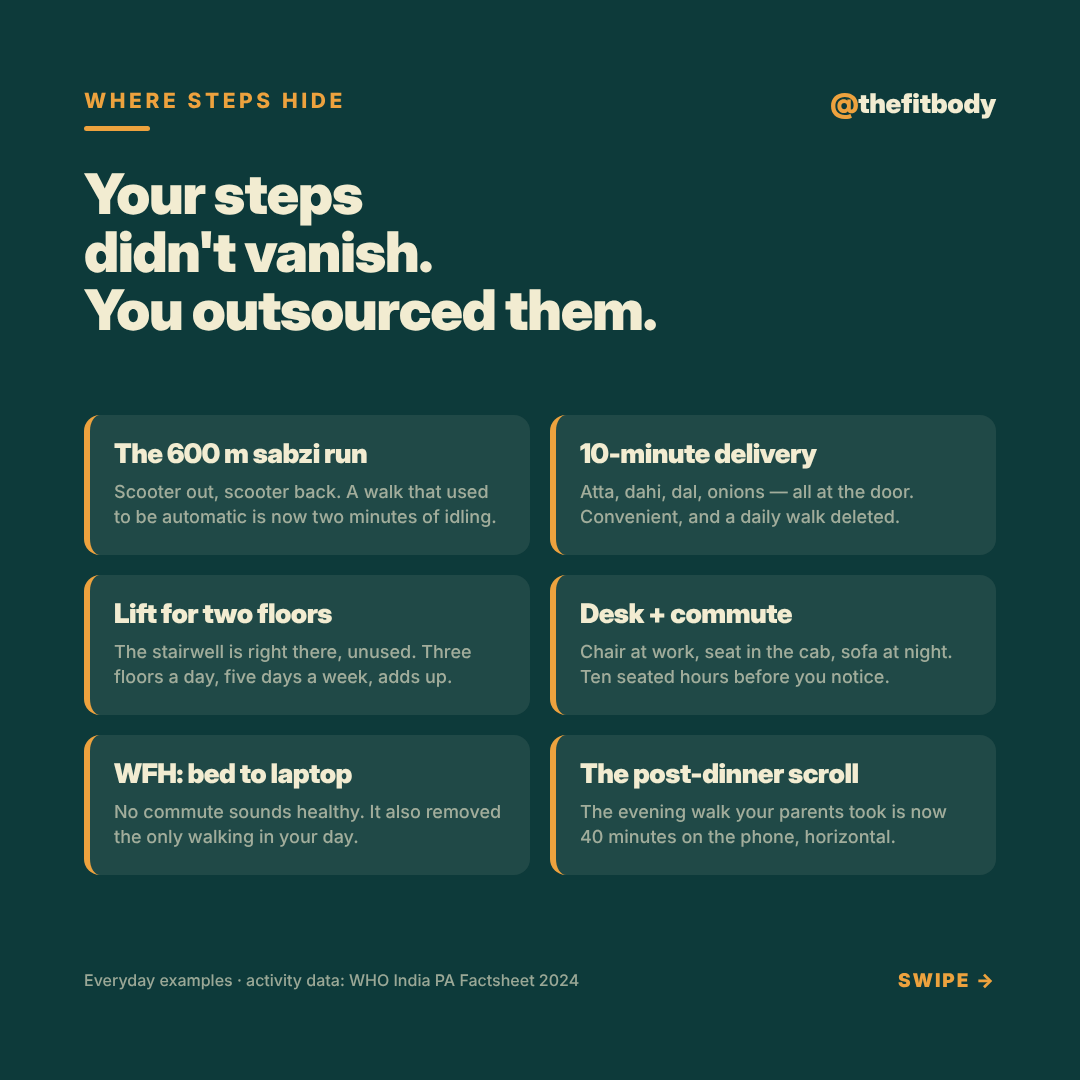
You didn’t lose them. You outsourced them.
- The 600 m sabzi run is now a scooter trip
- Atta, dahi, dal and onions arrive in 10 minutes
- Lift for two floors
- Desk, cab, sofa — ten seated hours before you notice
- The evening walk your parents took is now 40 minutes of scrolling
5 Things To Do Today
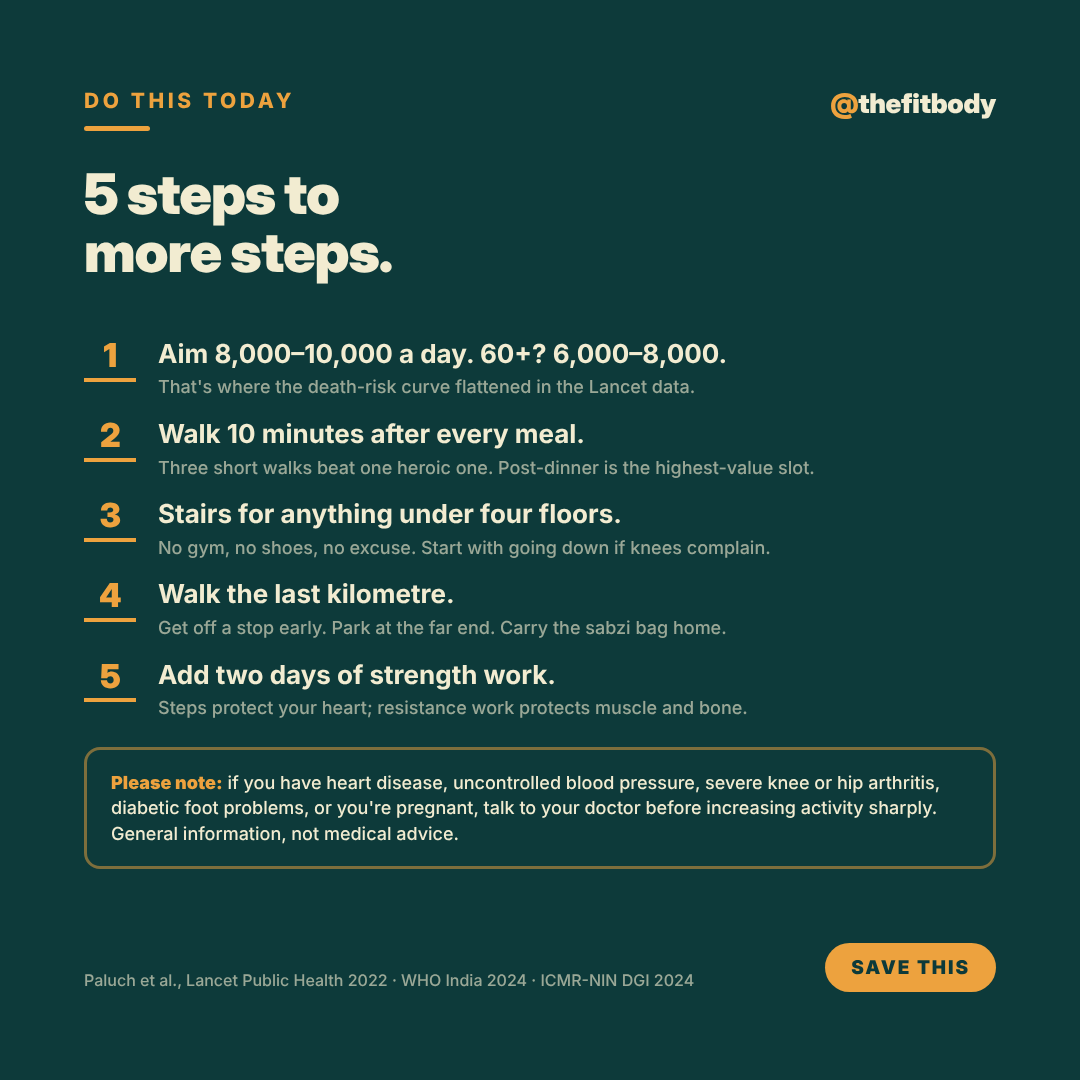
- Aim 8,000–10,000 steps. If you’re 60+, 6,000–8,000 is enough.
- Walk 10 minutes after every meal. Post-dinner matters most.
- Stairs for anything under four floors.
- Walk the last kilometre — get off a stop early, carry the sabzi bag home.
- Add two days of strength work.
A walk after dal-chawal costs nothing and beats any supplement on your shelf.
Small walks, big returns
If a long walk doesn’t fit your day, break it up. A ten-minute stroll after each meal adds up to thirty minutes, and walking after dinner is especially useful for post-meal blood sugar. Take the stairs for anything under four floors, get off one stop early, or carry the sabzi bag home on foot.
The carousel
The five slides from our Instagram and X post — swipe through them, save them, share them.
Sources
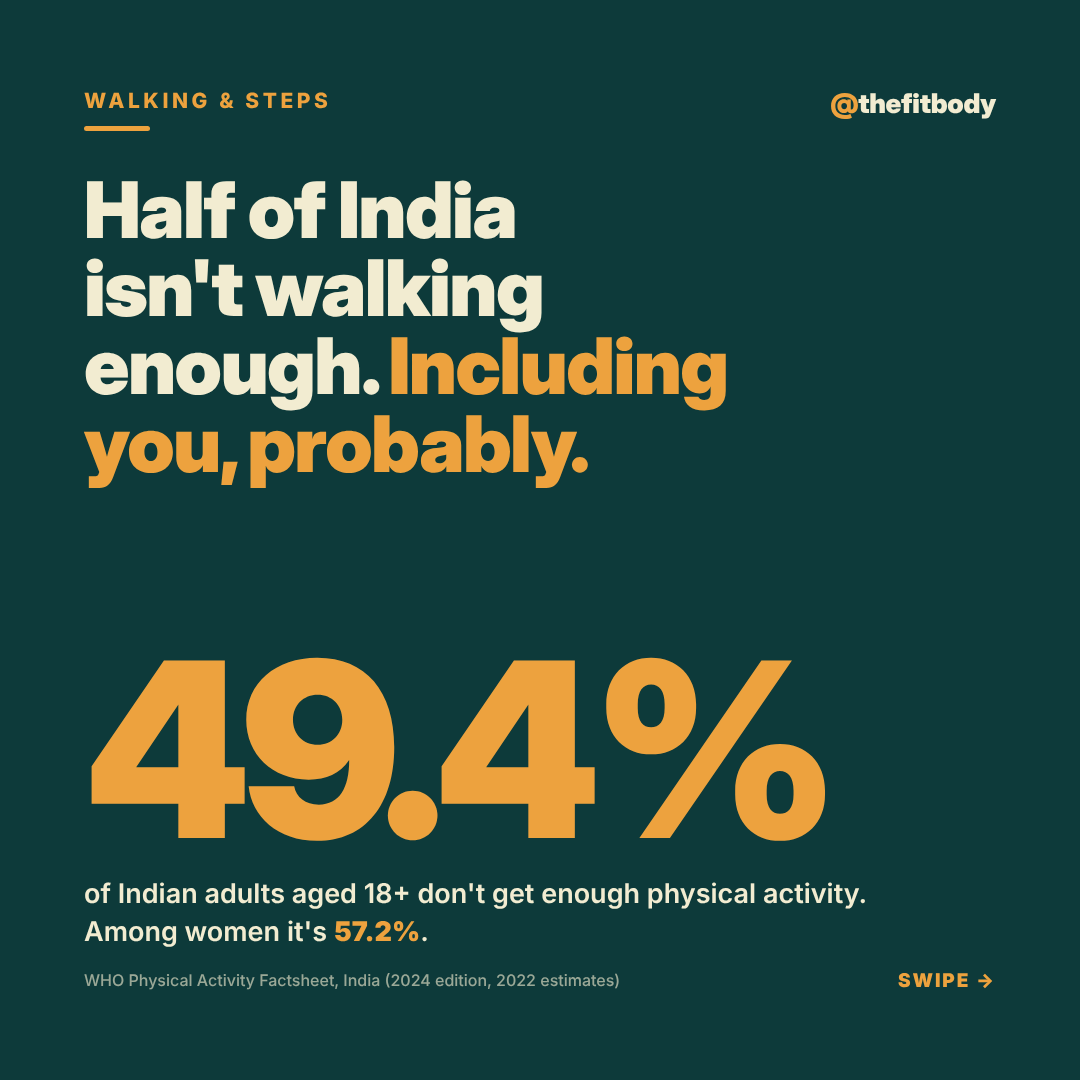
- WHO — Physical Activity Factsheet: India (2024)49.4% of adults 18+ insufficiently active (2022 estimate); men 42.0%, women 57.2%; adolescents 11–17: 74% overall, girls 76%, boys 72%.
- Paluch et al. — Daily steps and all-cause mortality: a meta-analysis of 15 international cohorts. The Lancet Public Health 2022;7(3):e219–e228Quartile medians 3,553 / 5,801 / 7,842 / 10,901 steps per day; hazard ratios vs the lowest quartile 0.60, 0.55 and 0.47 (the 40% / 45% / 53% figures on slide 2); risk plateaued at 6,000–8,000 steps for adults 60+ and 8,000–10,000 for under-60s.
- Anjana et al. — ICMR-INDIAB-17 national cross-sectional study. Lancet Diabetes & Endocrinology 2023;11:474–89Diabetes 11.4% (101 million); prediabetes 15.3% (136 million); abdominal obesity 39.5% (351 million).
- ICMR-NIN — Dietary Guidelines for Indians (2024)Healthy diets plus physical activity can prevent up to 80% of type 2 diabetes (slide 3 callout).
General information, not medical advice. Figures are taken from the sources above; if you have a medical condition, speak to your doctor before changing your diet or activity.