
Ask anyone how much sugar they take in their chai and they will tell you. Ask how much oil goes into the family’s cooking each month and most people have no idea. Nobody measures the oil — and that, quite literally, is the whole problem.
The good news is that you do not have to give up the tadka, the poori or the occasional pakora. A few habits — measuring, not reheating the same oil, and choosing better fats — make a big difference.
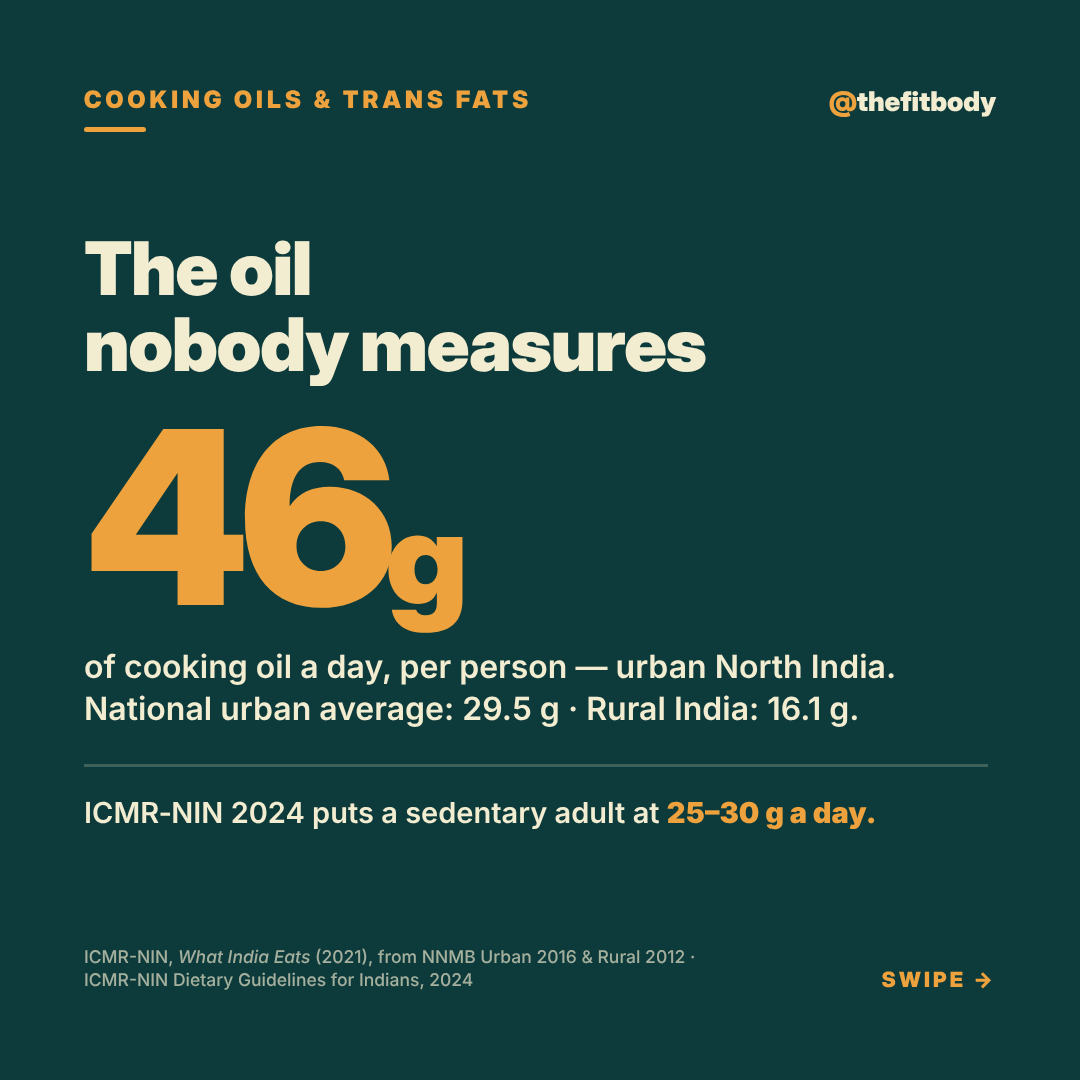
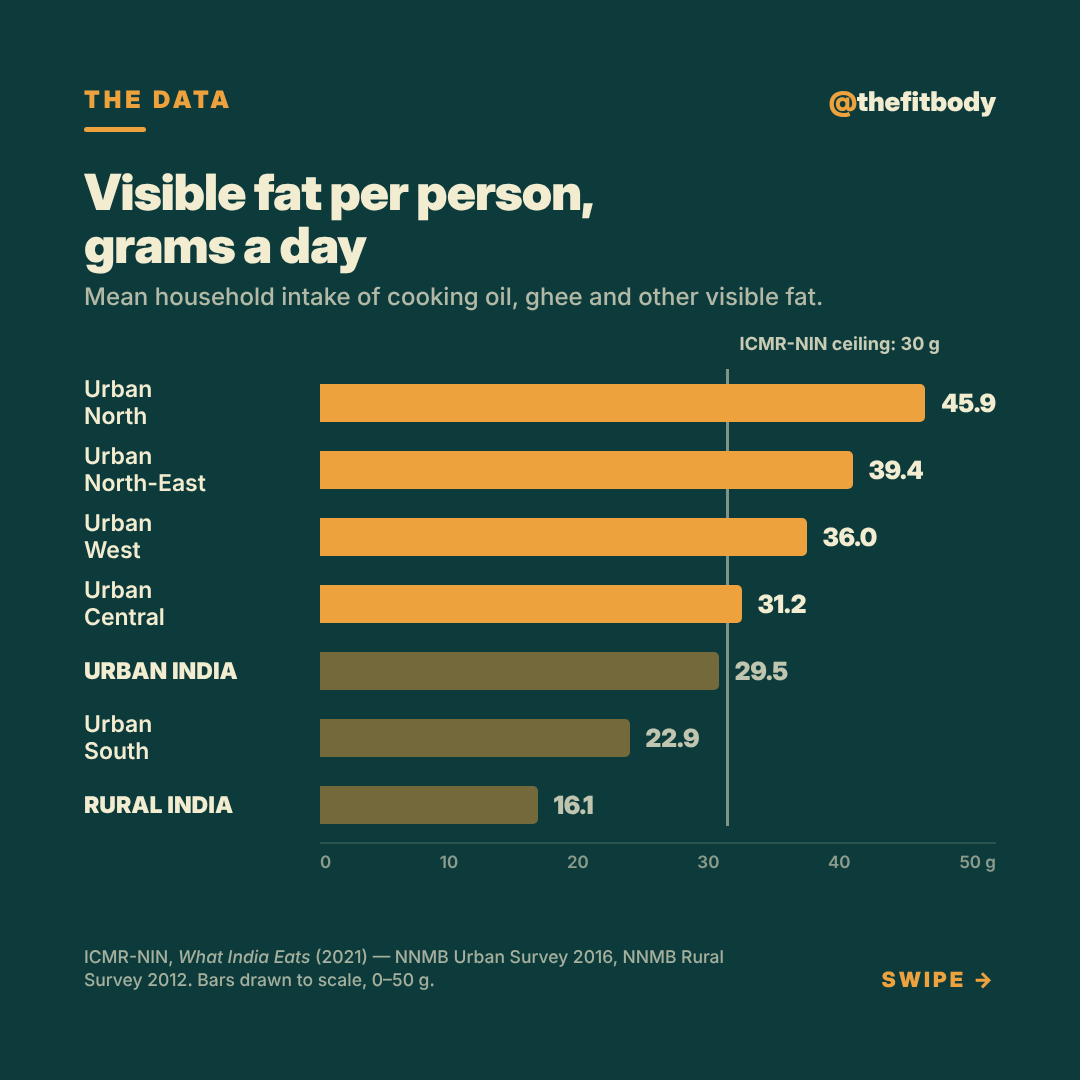
Urban North India: 45.9 g of visible fat a day, per person — oil, ghee, vanaspati.
ICMR-NIN 2024 guideline for a sedentary adult: 25-30 g.
Urban India: 29.5 g. Rural India: 16.1 g.
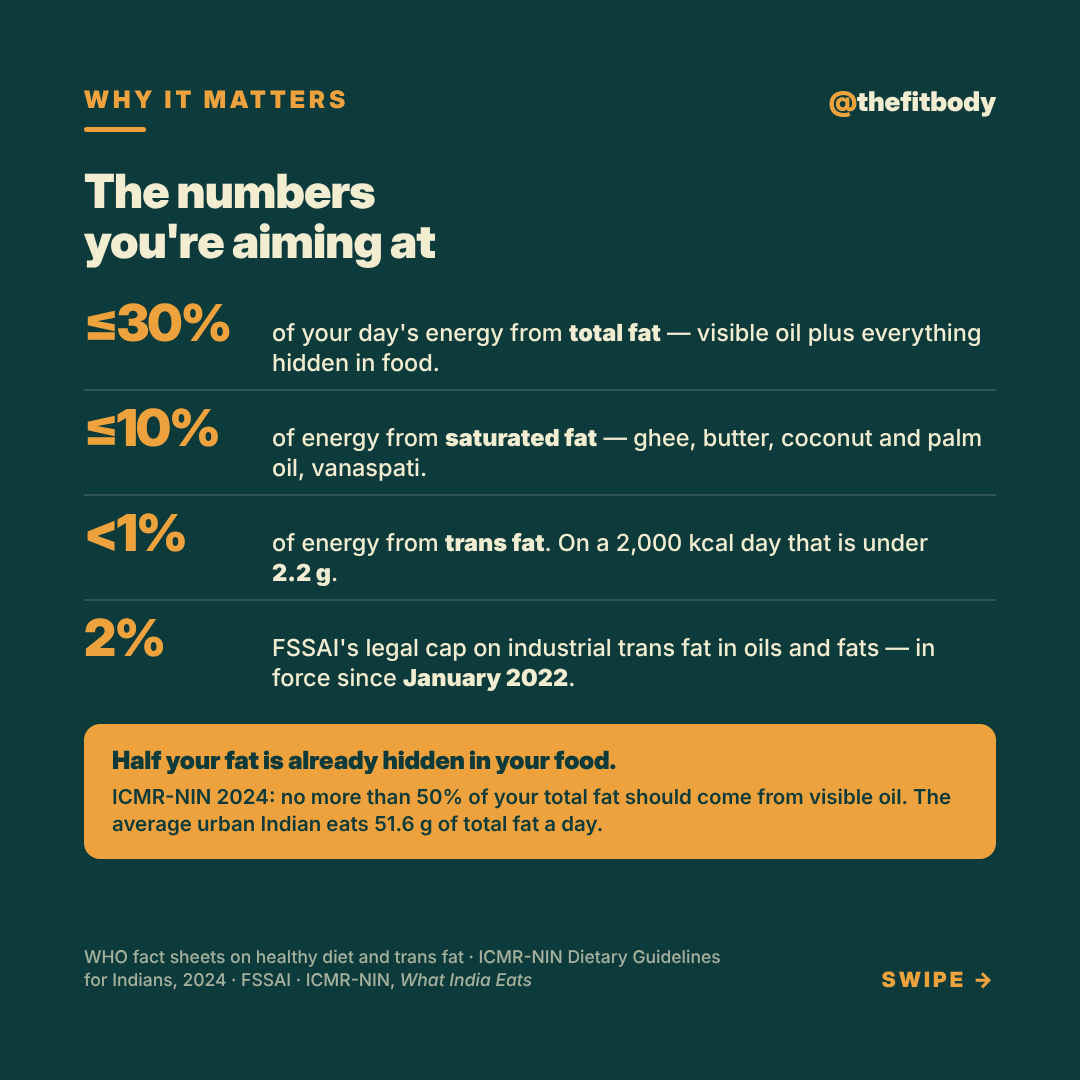
The Targets
- Total fat: up to 30% of your day’s energy (WHO, ICMR-NIN)
- Saturated fat: 10% or less (WHO)
- Trans fat: under 1% — under 2.2 g on 2,000 kcal (WHO)
- FSSAI’s legal cap on industrial trans fat: 2%, since Jan 2022
Where It Hides
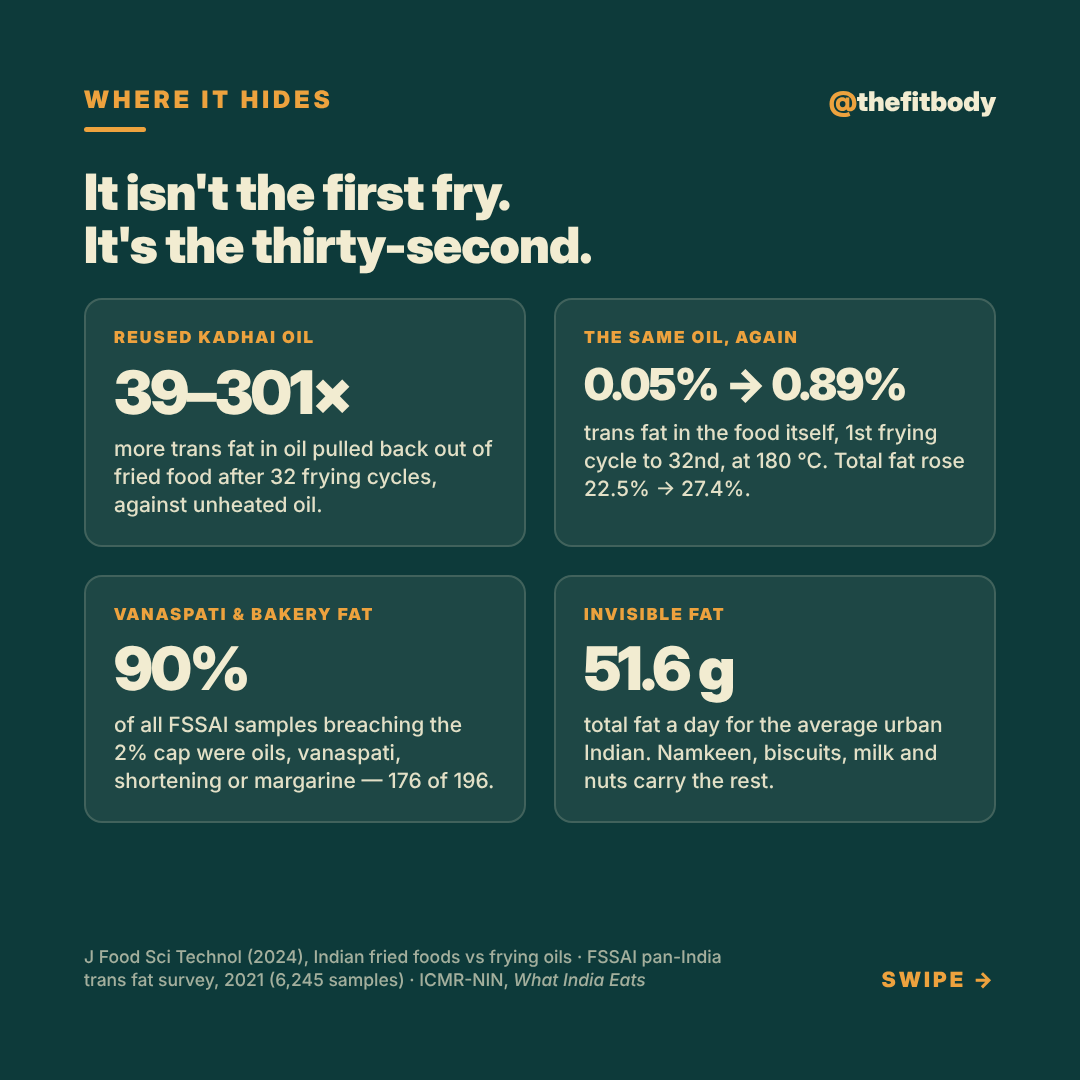
It isn’t the first fry. It’s the thirty-second.
A 2024 Indian study fried poori, bread pakora, mathri and chips in the same oil over and over. Trans fat in the oil pulled back out of that food was 39-301x higher after 32 frying cycles than in unheated oil. In the food itself: 0.05% to 0.89%.
That’s the stall reusing the kadhai all evening — and your kitchen, when leftover frying oil goes back in the bottle.
Of 6,245 packaged samples FSSAI tested, 196 broke the 2% cap — 176 were oils, vanaspati, shortening or margarine.
The average urban Indian eats 51.6 g of total fat a day — ICMR-NIN says visible oil should be under half of it. Namkeen, biscuits, milk and nuts carry the rest.
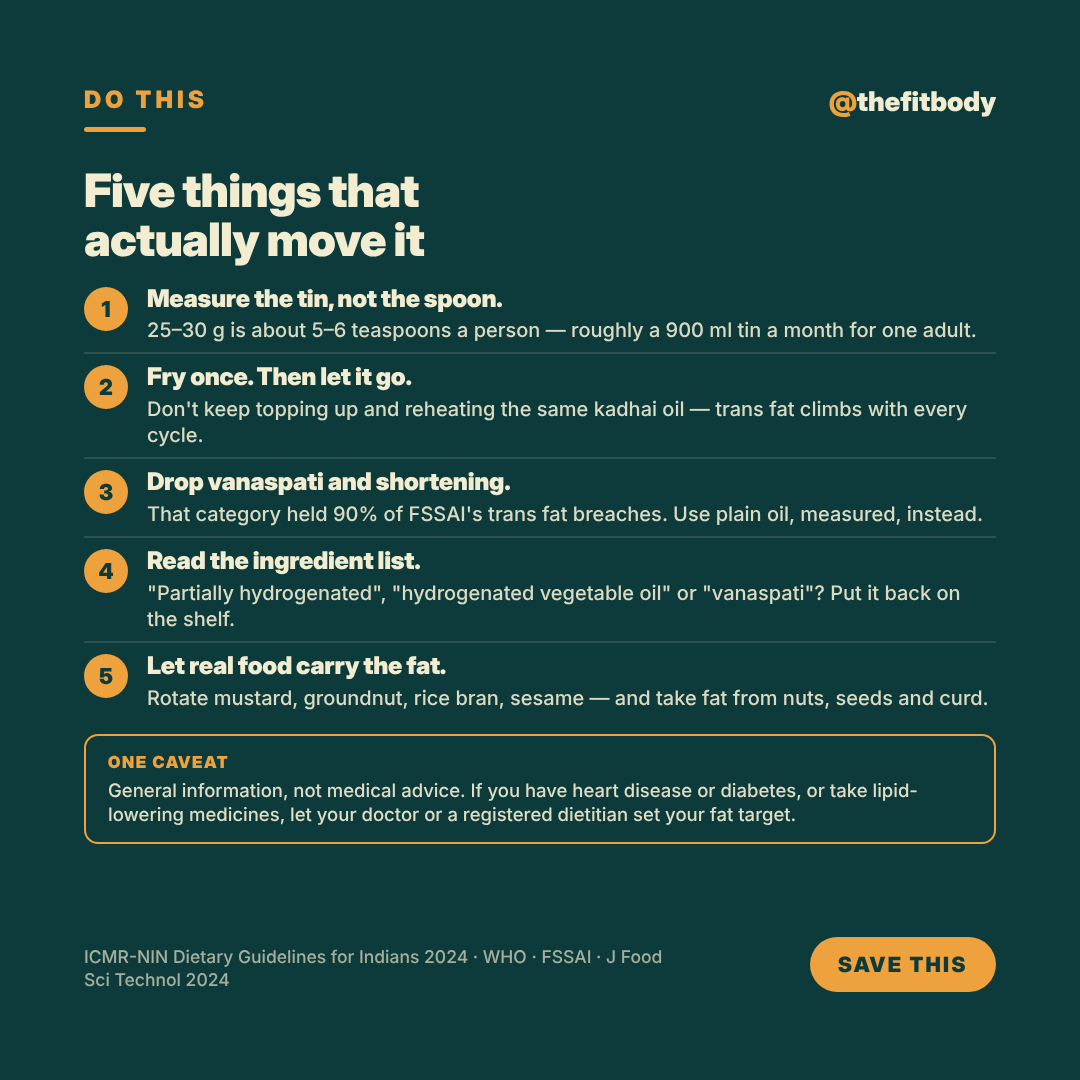
Five Things That Move It
- Measure the tin, not the spoon. 25-30 g is 5-6 tsp a person — about one 900 ml tin a month per adult.
- Fry once, then let it go. Stop reheating the same kadhai oil.
- Drop vanaspati, shortening and margarine. Plain oil or ghee, measured.
- Read the ingredient list. “Partially hydrogenated” or “vanaspati”? Put it back.
- Let real food carry the fat. Rotate mustard, groundnut, rice bran, sesame. Get fat from nuts, seeds and curd.
Dal, roti and sabzi don’t need a swimming pool of oil. The tadka does its job in a teaspoon.
Reused oil: the hidden problem
The issue is rarely the first fry — it is the thirtieth. That is the roadside stall reusing the same kadhai all evening, and the home kitchen where leftover frying oil quietly goes back into the bottle. Treat frying oil as single-use, or fry once and move it to a different use, and let it go.
The carousel
The five slides from our Instagram and X post — swipe through them, save them, share them.
Sources
- ICMR‑NIN — Dietary Guidelines for Indians, 202425–30 g of visible fat a day for a sedentary adult (30–40 g with moderate activity) · total fat at or under 30% of daily energy · avoid partially hydrogenated vegetable oil (vanaspati).
- ICMR‑NIN — What India Eats, 2021Every bar on slide 2: urban North 45.9 g, North‑East 39.4, West 36.0, Central 31.2, urban India 29.5, urban South 22.9, rural India 16.1 · 51.6 g total fat a day for urban Indians · visible oil should be no more than 50% of total fat. Underlying surveys: NNMB Urban 2016 and NNMB Rural 2012.
- WHO — Trans fat fact sheetTrans fat under 1% of total energy, which is under 2.2 g on a 2,000 kcal day · best‑practice policy of 2 g industrial trans fat per 100 g of total fat.
- WHO — Healthy diet fact sheetTotal fat 15–30% of daily energy · saturated fat no more than 10% · trans fat no more than 1%.
- FSSAI — Pan‑India trans fat survey, September 20216,245 packaged samples · 3.14% (196 samples) above the 2% cap · 176 of those 196 were oils, vanaspati, shortening or margarine · of 1,069 products in that category, 100 fell between 2% and 3% and 76 were above 3%.
- FSSAI — Trans fat limits in oils and fats3% or less from January 2021, 2% or less from January 2022, across oils and fats used in food.
- Journal of Food Science and Technology, 2024 — Indian fried foods versus the oils used for fryingTrans fat in the food 0.05% at the 1st frying cycle to 0.89% at the 32nd, at 180 °C · 39–301× more trans fat in oil extracted from fried food after 32 cycles than in unheated oil (20–264× in the frying oil itself) · total fat 22.5% to 27.4% · foods tested: poori, bread pakora, mathri, potato chips, French fries.
General information, not medical advice. Figures are taken from the sources above; if you have a medical condition, speak to your doctor before changing your diet or activity.