
Scroll through any Indian health feed and you will find endless debate about protein. Fibre rarely gets a mention — yet it is the nutrient that quietly shapes digestion, blood sugar, cholesterol and long-term heart health.
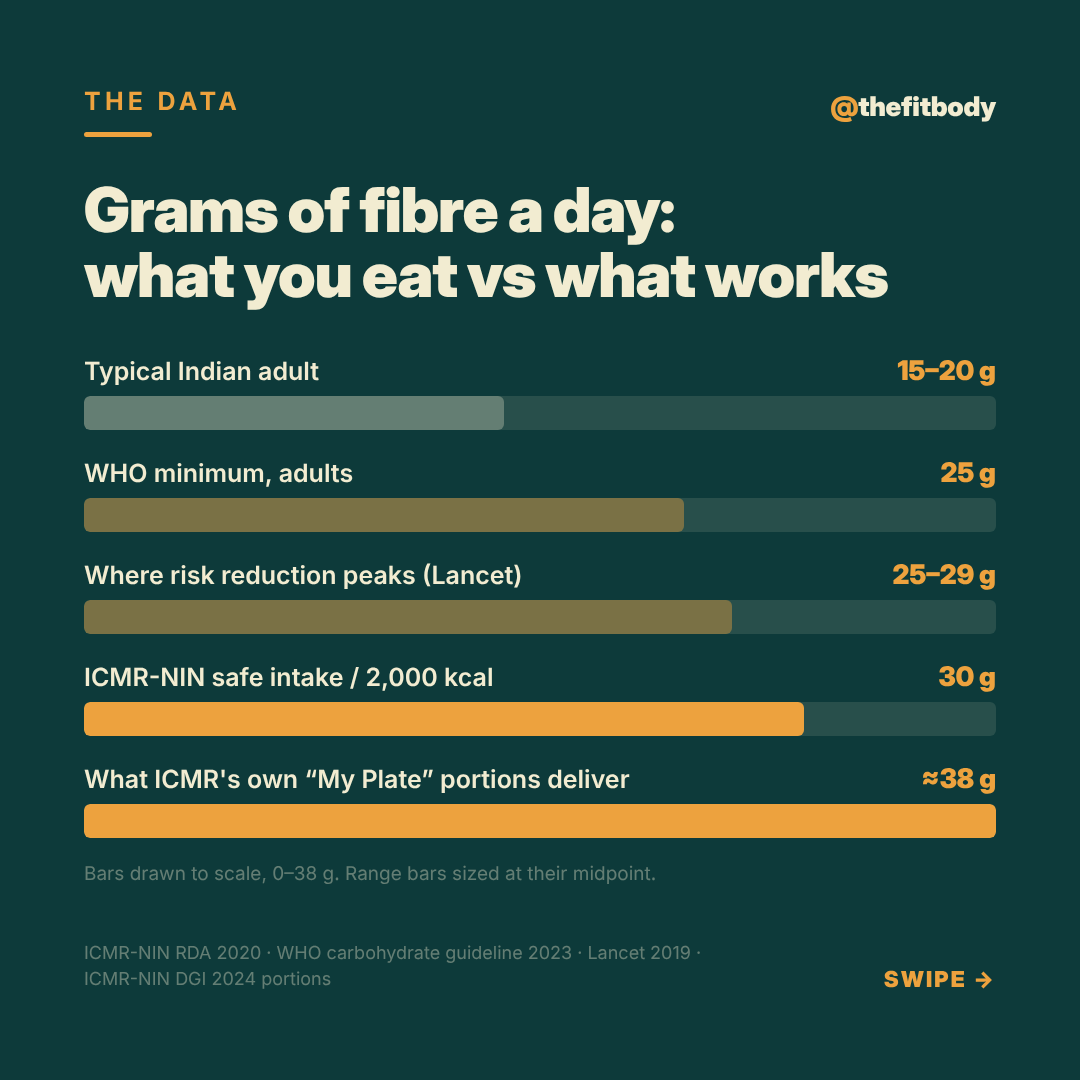
The surprising part: you do not need exotic foods or supplements to close the gap. If you simply follow ICMR-NIN’s own recommended portions, the maths works out to about 38 g of fibre a day.
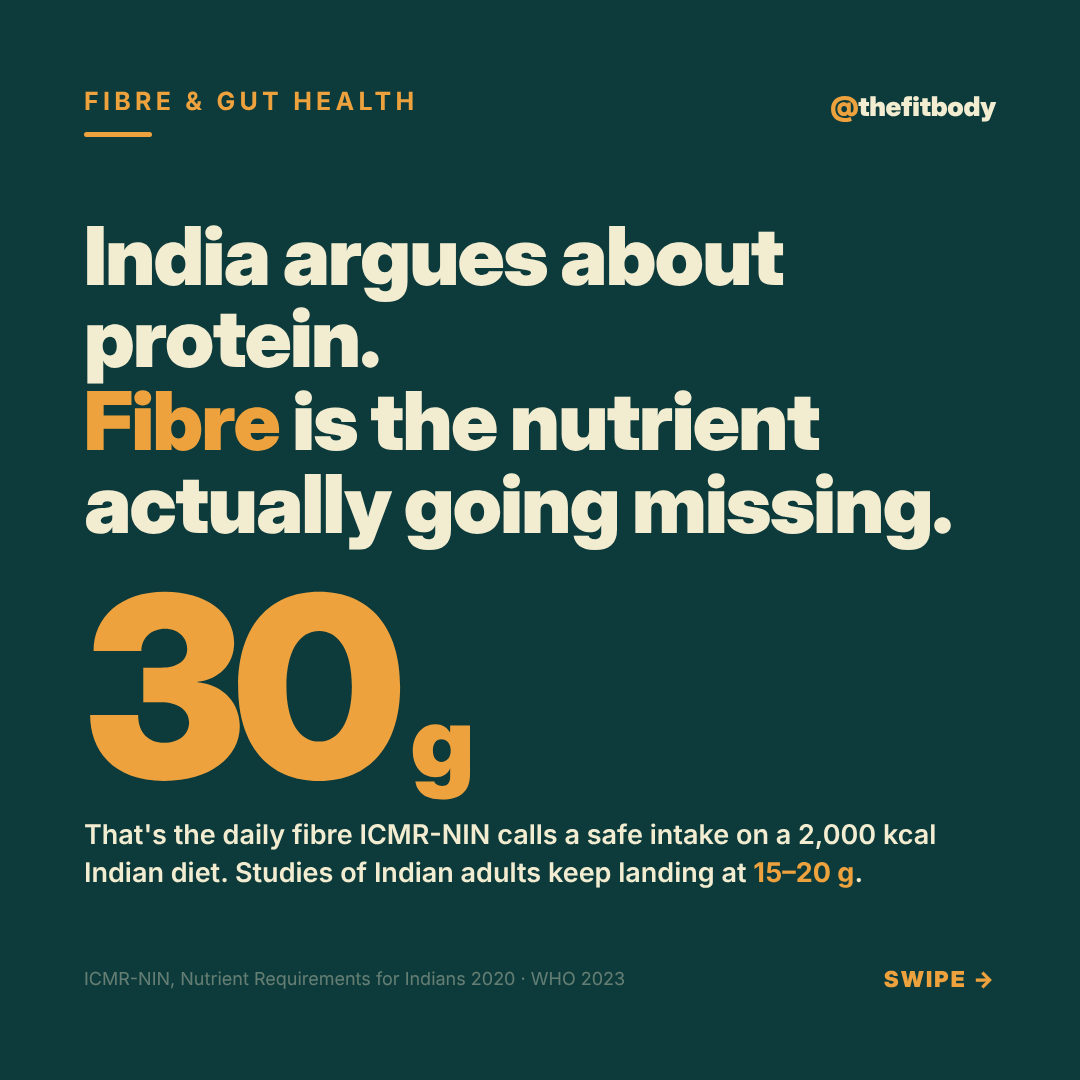
ICMR-NIN calls 30 g a day a safe fibre intake on a 2,000 kcal Indian diet.
WHO says at least 25 g.
Studies of Indian adults keep landing at 15-20 g.
Why it’s worth fixing:
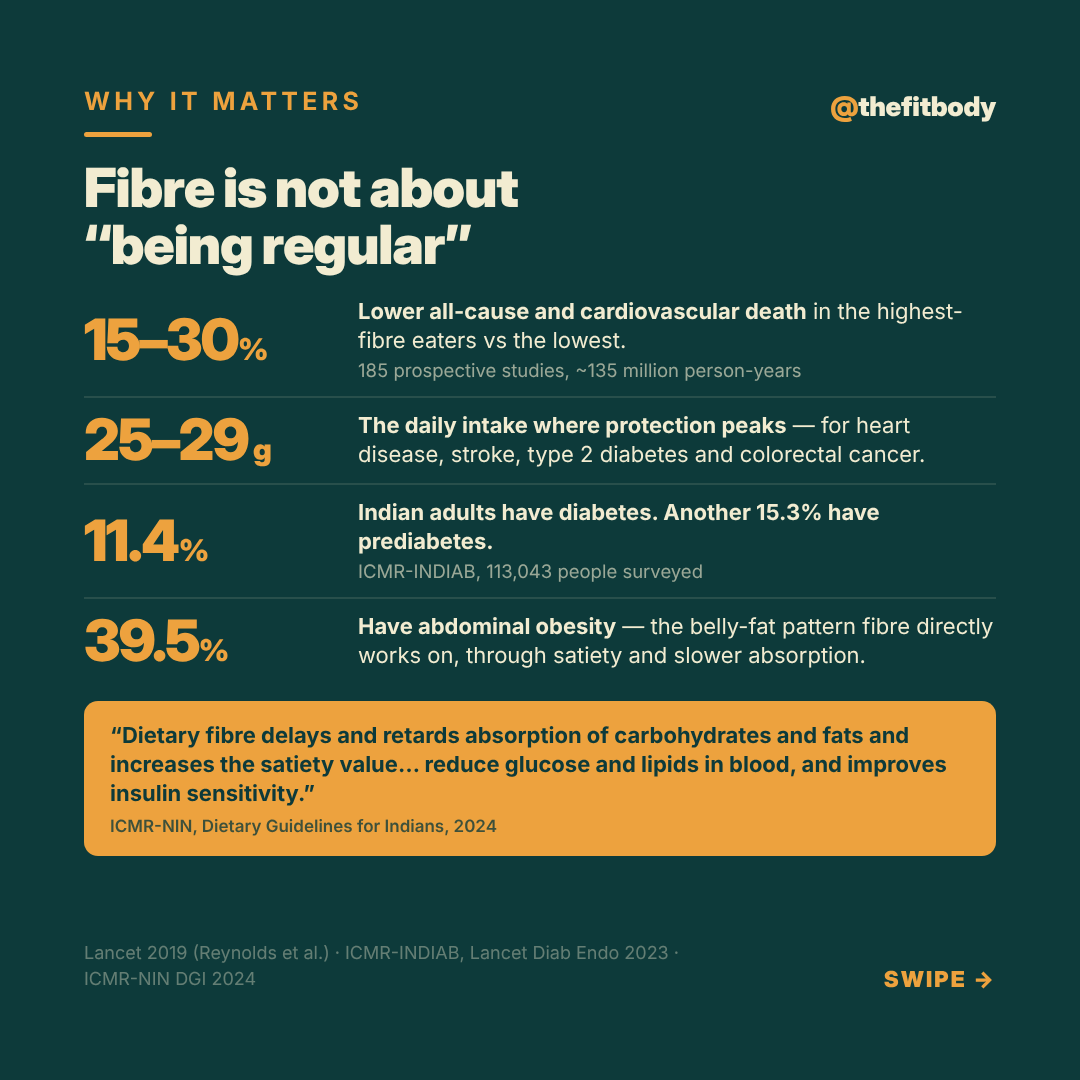
The highest-fibre eaters have 15-30% lower all-cause and cardiovascular death than the lowest. That’s 185 studies and ~135 million person-years (Lancet 2019). Protection peaks at 25-29 g a day.
Meanwhile ICMR-INDIAB found 11.4% of Indian adults have diabetes, 15.3% have prediabetes, and 39.5% carry abdominal obesity. Fibre slows the absorption of carbs and fats, lowers blood glucose and lipids, and improves insulin sensitivity. ICMR-NIN says so in its own 2024 guidelines.
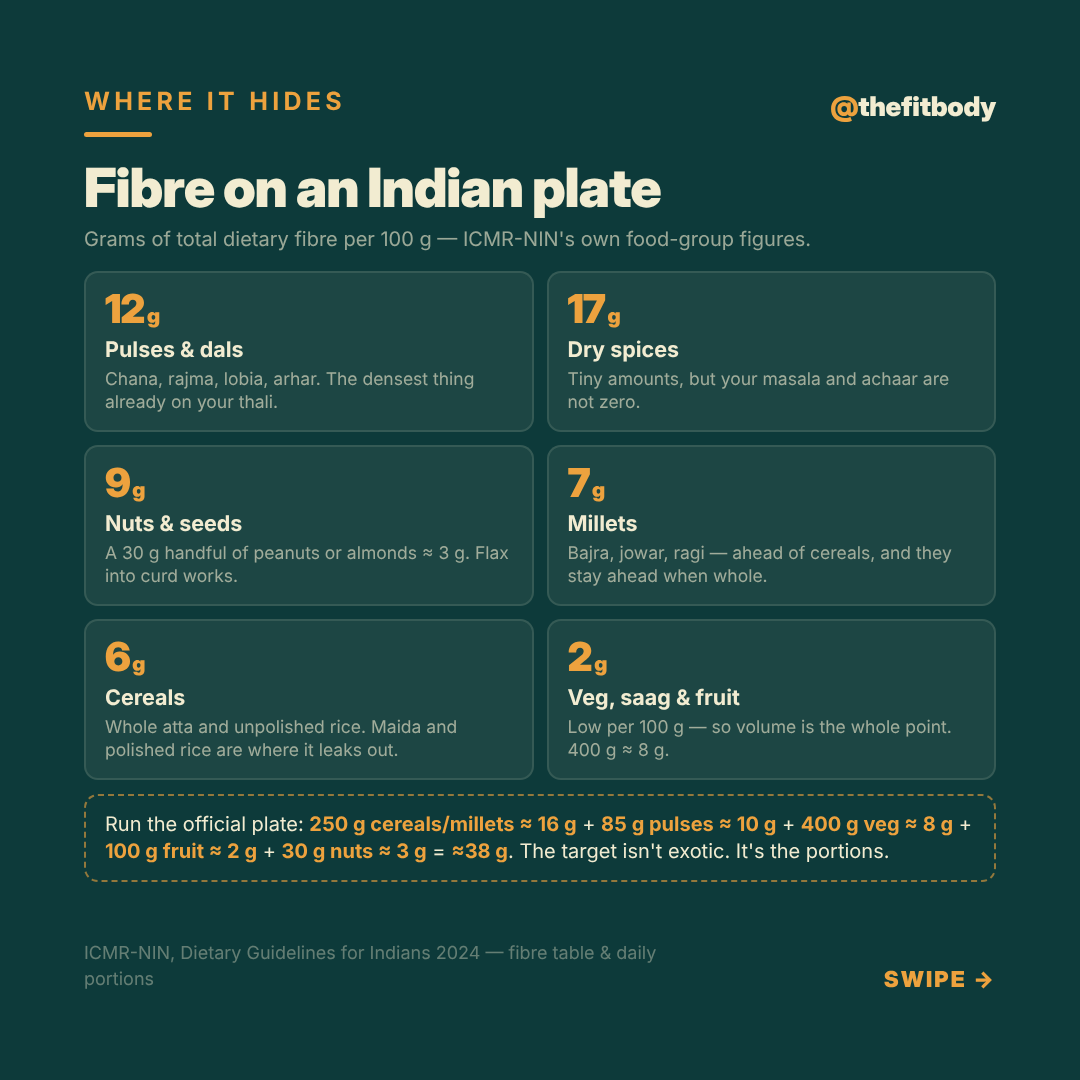
Where fibre sits on your plate (g per 100 g, ICMR-NIN):
Pulses and dals 12 g
Nuts and seeds 9 g
Millets 7 g
Cereals 6 g
Veg, saag and fruit 2 g
Now run the official plate: 250 g cereals and millets (16 g) + 85 g pulses (10 g) + 400 g veg (8 g) + 100 g fruit (2 g) + 30 g nuts (3 g) = about 38 g.
The target isn’t exotic. It’s the portions.
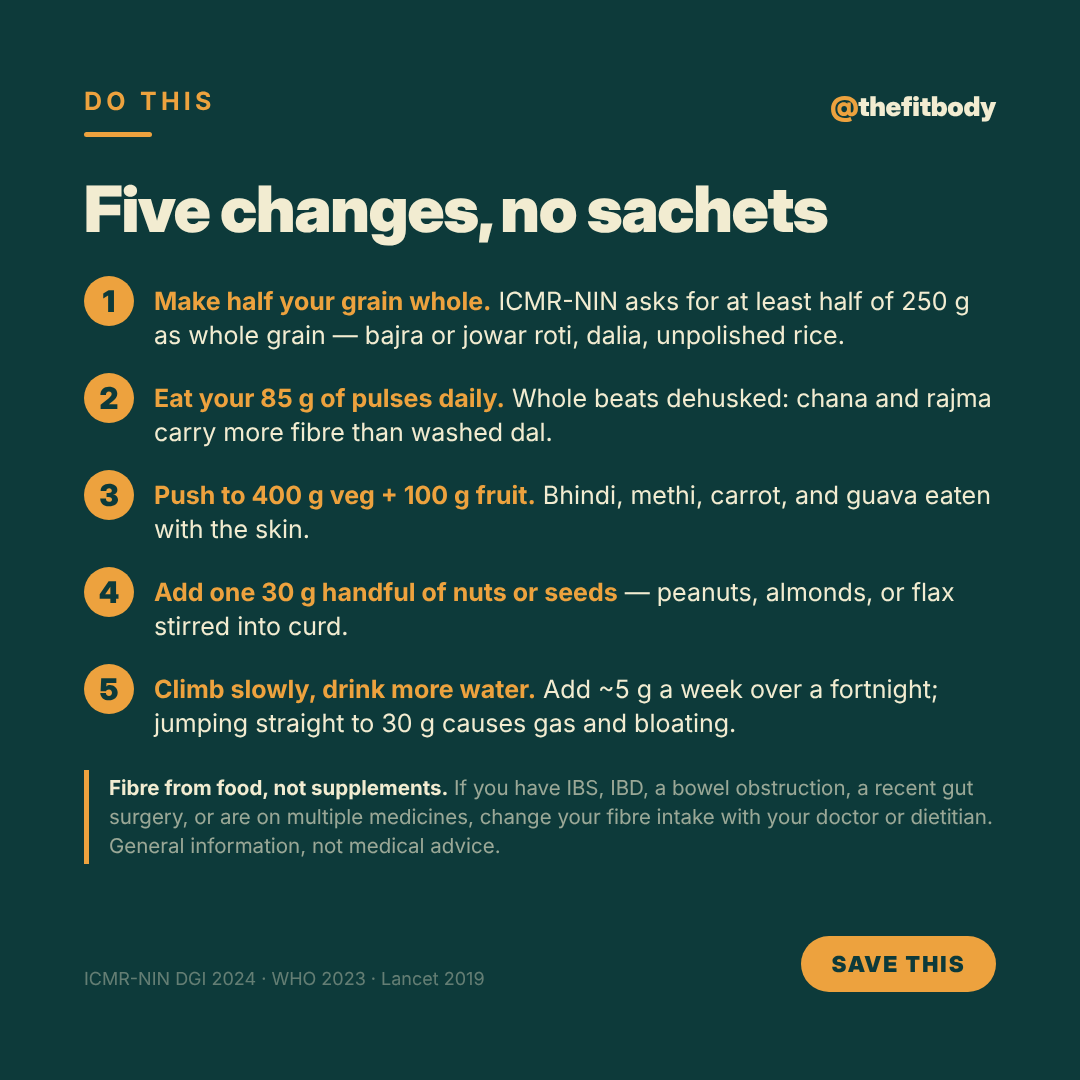
Five changes, no sachets:
- Make half your grain whole. Bajra or jowar roti, dalia, unpolished rice.
- Eat your 85 g of pulses daily. Whole chana and rajma beat washed dal.
- Push to 400 g veg + 100 g fruit. Bhindi, methi, carrot, guava with the skin.
- Add one 30 g handful of nuts or seeds. Peanuts, almonds, flax in your curd.
- Climb slowly and drink more water. Add about 5 g a week over a fortnight. Jumping straight to 30 g causes gas and bloating.
Fibre from food, not supplements. If you have IBS, IBD, a bowel obstruction, a recent gut surgery, or are on multiple medicines, change your fibre intake with your doctor or dietitian first.
Why fibre matters more in India
With 11.4% of Indian adults living with diabetes, 15.3% with prediabetes and 39.5% carrying abdominal obesity, fibre is one of the simplest tools we have. It slows the absorption of carbohydrates and fats, helps lower blood glucose and lipids, and improves insulin sensitivity.
The carousel
The five slides from our Instagram and X post — swipe through them, save them, share them.
Sources
- ICMR-NIN — Nutrient Requirements for Indians (RDA/EAR), 2020The 30 g per 2,000 kcal safe fibre intake, and 30 g/day for sedentary men, 25 g/day for sedentary women. Slides 1 and 2.
- WHO — Guideline on carbohydrate intake for adults and children, 2023The ≥25 g/day adult fibre minimum and the 400 g vegetables-and-fruit target. Slides 2 and 5.
- Reynolds et al. — Carbohydrate quality and human health, The Lancet, 201915–30% lower all-cause and cardiovascular mortality, highest vs lowest fibre intake; protection greatest at 25–29 g/day; 185 prospective studies, ~135 million person-years. Slides 2 and 3.
- ICMR-INDIAB — Lancet Diabetes & Endocrinology, 2023 (n = 113,043)Diabetes 11.4%, prediabetes 15.3%, abdominal obesity 39.5% . Slide 3.
- ICMR-NIN — Dietary Guidelines for Indians, 2024Fibre per 100 g by food group (pulses 12 g, dry spices 17 g, nuts 9 g, millets 7 g, cereals 6 g, vegetables/fruit 2 g); daily portions of 250 g cereals (at least half whole grain), 85 g pulses, 400 g vegetables, 100 g fruit; and the quoted line on glucose, lipids, insulin sensitivity and stool bulk. Slides 3, 4 and 5.
General information, not medical advice. Figures are taken from the sources above; if you have a medical condition, speak to your doctor before changing your diet or activity.